1957 Sebring 12-Hour Grand Prix – Race Profile Page Five
By 3 p.m. there were 15 cars officially withdrawn with one of them being the Corvette SS. Word was that persistent overheating problems led to the withdrawal. The official records showed the cause to be failed rear suspension. There were also two more cars in the pits for lengthy repairs. Fangio was still in the lead and Moss finally decided to turn his car over to his co-driver, Harry Schell. After waiting for 5 hours Schell was probably wondering if he would ever get a chance to drive. Lou Brero brought his #15 Ferrari 290 S into the pits and collapsed due to the heat. Masten Gregory took over. Brero recovered and returned later.
The burning sun and relentless heat were taking their toll on the spectators with many seeking any shady spot they could. Several of the concession stands temporarily ran out of cold beverages. Literally hundreds and hundreds of empty drink cups littered the ground in the spectator enclosure and the 55 gallon oil drums being used as trash receptacles were overflowing.
At 3:19 p.m. Portago brought in his #12 Ferrari 315 S with serious brake trouble. The mechanics couldn’t seem to remedy the problem and the car returned to the race with Luigi Musso at the wheel. Portago said the car has “no brakes.” Right before 4 p.m. Hawthorn brought in his D-Jag for a remarkably quick 6-minute brake change. Remarkable when you consider they had to reline the brakes on the Jag instead of change pads.

Jean Behra in the Maserati 450S leads the Maserati 150S that was driven by Lloyd Ruby and Bobby Burns. Behra’s car came in first and the Ruby/Burns car was a DNF. Photo by Bernard Cahier and courtesy of Maserati

The #51 MG A of David Ash and Gus Ehrman races the Lotus Eleven Le Mans of Doc and Margaret Wyllie. The MG finished 27th but the Lotus was disqualified. Photo courtesy of Dave Nicholas

Doc Wyllie pushes his Lotus Eleven Le Mans into the pits during the race. He co-drove with his wife Margaret. He was later disqualified for getting assistance on the course. Photo courtesy of Dave Nicholas

Chevrolet Corvette SR-2 of Paul O’Shea and Pete Lovely. This car was part of the four-car team entered by General Motors. The car finished 16th. Photo courtesy of General Motors Media Archives

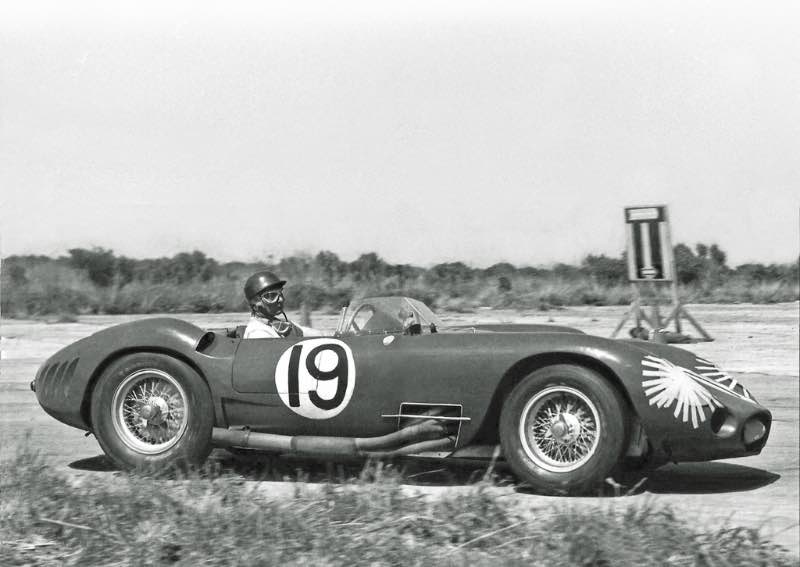
Stirling Moss in his second place Maserati 300S that he co-drive with Harry Schell. Spectators were amazed to see Moss pull down his driving goggles during the race and sometimes take his hand off the wheel at high speeds to shade his eyes from the setting sun. Photo by Bernard Cahier and courtesy of Maserati
At the half-way point (4 p.m.) Fangio still led but a major mistake by the Maserati team led to a disqualification for one of their cars. It seemed that both Fangio and Carroll Shelby were running low on fuel. Shelby brought in his #21 Maserati 250 S and had just begun refueling when he was told to get back on the course because Fangio was coming in. After Fangio was serviced, Shelby returned for much needed fuel but was immediately disqualified. There was an FIA rule that you had to drive at least 20 laps before you can come in for more gas and the Maserati pits had forgotten about that rule. Maserati was forced to retire the car.
Between 4 & 6 p.m. Fangio and Behra maintained their lead. The Hill/von Tripps Ferrari came in for a regular pit stop but refused to start (dead battery) and was retired. The angle of the sun at that time of day was blinding for some of the drivers. Spectators were amazed when they observed Moss, sans goggles, take one hand off the steering wheel of his Maserati to shade his eyes as he went through the hairpin.
Drivers at Sebring that year commented later about the driving ability of Juan Fangio. While they were constantly fighting the steering wheel going through the turns they were amazed to watch Fangio take each turn gently holding the steering wheel on the big 4.5 Maserati turning it a little this way and a little that way. To some of them it seemed that Fangio was out for a Sunday drive. “He didn’t ever look like he was racing,” said Lotus driver Joe Sheppard.
By 8 p.m. Fangio was still first with Hawthorn, Portago and Schell following. That order hadn’t changed in over an hour. Portago had to pit because of a problem with his fuel pump. The stop cost him 30 minutes. Moss continued to gain on the leaders.
At 9 p.m. Fangio was still at the wheel of his car and was now four laps ahead. Because of pit stops and driver changes Moss was now in second with Hawthorn third, Masten Gregory fourth and Walt Hansgen fifth. Peter Collins was way off the pace with four minute laps due to failing brakes. The small but reliable Porsches were now in 8th, 9th and 10th position. They also had the Index of Performance well in hand.
At 9:30 there was some commotion in the Maserati pits. It seemed that during the scheduled final pit stop a mechanic had spilled a large quantity of gasoline on Fangio’s seat. If you ever wondered why drivers were required to exit the car during refueling then here is your answer.
In typical Italian fashion there was a lot of yelling and hand gestures. The team manager went off to find a replacement seat. They found one and Fangio returned to the race with his lead now at four laps. Just 30 minutes to go and everyone in the Maserati pits was holding his breath.
At 10 p.m. fireworks appeared over the track. It signaled the end of the race and a tremendous victory for Maserati. Coming in first were Fangio and Behra at the wheel of their Maserati 450 S with the Moss/Schell Maserati 300 S second. Mike Hawthorn and Ivor Bueb were third in their Jaguar D-Type, Masten Gregory and Lou Brero were fourth in a Ferrari 290 S, Walt Hansgen and Russ Boss were fifth in a Cunningham D-Type Jag, Peter Collins and Maurice Trintignant were sixth in a factory Ferrari 315 S, Alfonso de Portago and Luigi Musso were seventh in factory Ferrari 315 S, Art Bunker and Charles Wallace were eighth in a Porsche 550 RS, Jean Pierre Kunstle and Ken Miles were ninth in a Porsche 550 RS, Howard Hively and Richie Ginther were tenth in a Ferrari 500 TRC. Bunker and Wallace also came away with a first in the Index of Performance which rated cars according to performance.

Winner’s circle at Sebring in 1957. Juan Manuel Fangio and Jean Behra broke all records in winning the race in their Maserati 450S. Photo by Bernard Cahier and courtesy of Maserati
When Fangio brought the winning car into the pit area he was surrounded by fans and press alike. Under the bright lights of the motion picture cameras he graciously called over Jean Behra to join him in the victory celebration. Dozens of flash bulbs were going off at once. Once the camera lights were turned off and the flash bulbs faded Fangio unexpectedly excused himself and left Behra alone to talk to the people from the print media. Some reporters felt slighted by his quick departure.
Not until several days later was it revealed that Fangio left early to get medical attention for painful burn blisters he was suffering from his waist down to his knees on his right side. It seems that the insulation on the exhaust pipes, which ran along the driver’s side of the car, had worn away and his lower body was exposed to very hot temperatures. His discomfort had not been evident when he brought the car into the winner’s circle.
So, for those last three-and-one-half hours of the race El Chueco (“Knock-Kneed”) drove riding a very hot seat. No wonder his other nickname was El Maestro or “The Master.”
1957 Sebring 12-Hour Grand Prix Epilogue:
The winning car of Fangio and Behra was 20 miles ahead of the second place Moss/Schell Maserati at the finish. They broke all existing Sebring records establishing a new distance record of 1,024.4 miles, a new average speed of 85.45 mph and Behra’s time of 3 minutes, 24.5 seconds was an amazing five seconds faster than the record set by Mike Hawthorn in 1956, driving for Jaguar.
Juan Manuel Fangio would go on to win his fifth and final World Driver’s Championship in 1957. This record would not be broken for 46 years.
The 1957 Sebring race would be Fangio’s last appearance at this event as a driver. In February of 1958 Fangio would be kidnapped by Fidel Castro’s rebels while at the Cuban Grand Prix. The rebels released Fangio after the race unharmed. Until his death Fangio and Castro would remain friends.

Juan Manuel Fangio would win his 5th and final World Driver’s Championship in 1957. That record would stand for 46 years. Photo by Bernard Cahier and courtesy of Maserati
The Corvette Super Sport (SS) would never race competitively again because General Motors would sign on to the Automobile Manufacturer’s Association opposition to factory involvement in racing. To celebrate the first race at the new Daytona International Speedway in 1959, General Motors brought out the retired Corvette Super Sport. It did a lap of 155 mph during the opening-day ceremonies.
On December 1, 1957 Maserati announced that it would be withdrawing from factory support for racing because they were losing money. However, they would continue to build race cars for private entries.
For Further Reading & Listening:
The Sebring Story, Alec Ulmann, Chilton Book Company, 1969
“The Sebring-Winning Special, Escape Roads,” Autoweek January 5, 2004, p.29
The Sounds of Sebring 1957, Riverside Records, Bill Grauer Productions
“Fantastico Is For Fangio,” Kenneth Rudeen, Sports Illustrated Magazine, April 01, 1957
[Source: Louis Galanos]


Louis – You’ve done it again mate!
Thanks much for bringing this wonderful era of racing back to life. The days of Fangio, Moss…Maserati…oh my, what an era. And so well written too. I knew who won in advance, but I was still on the edge of my seat. Brilliant.
Louis
Wonderful report. Could you do another one in a couple of weeks on the 2011 Sebring race?
Please.
Great! Your archive of back in the day racing will be a lasting memory.
I can remember these images from the time. They are the images that inspired me to first take a camera to the track. Good writing combined with marvelous images. Hope to see more of both soon.
Louis, Great article, this 1957 favorite Sebring Race was my favorite 12 hour, as I was a Huge fan of Juan Manuel Fangio and his 4.5 liter Maserati. This was real endurance racing back in the days, prompted me to buy the Sebring Album. WoW, its been a long time ago, Thanks Lou and SCD for the fine article and spectacular pics!
Cheers!
Tony a2z Racer
http://www.a2zracer.com
http://www.a2zracergear.com
Lou,Another great story and pictures. Thanks to you,I now
subscribe to Sports Car Digest. Bill
Merci pour ce beau texte et ces aventures qui rappellent une si bonne époque. Comme vous le savez je suis un passionné de l’histoire Ferrari mais je ne suis pas insensible à ces beaux reportages.
On en redemande.
Cordialement.
Mr Grangeon.
I believe Mr. Grangeon has said:
‘Thank you for this beautiful text and the adventures that recall such a good time. As you know I’m a fan of Ferrari’s history but I am not insensitive to these beautiful stories. We want more. Regards. Grangeon mr.’
Courtesy of Google Translate.
Lou,
Another great story. This was my first Sebring race which I attended during Spring Break. It brings back fond memories. I’m looking forward to your next one.
Bill
Lou,
Thanks for this great piece. For a guy that was too young to have been there, your words do a great job of putting the reader right there as it happened.
Thanks too for all the Corvette SS insight. Very cool to read.
Cheers!
Will Silk
Come on Will, you can’t be that young. Jamie keeps referring to you as “that old goat.”
HAHA! Let’s just say that Mario Andretti was driving for Lotus at the time my feet hit the tarmac.
Fantastic! A perfect mix of talent, passion, dedication, preparation, skill, and hard work.
Another great article, Lou.
I really enjoyed seeing and reading …and remembering what I saw many years ago along with some additional details that I never knew. The Corvette SS surely had the best paint job, but the Maserati’s were faster and reliable.
Wonderful article and photos! I had no idea the Corvette SS had that much potential….shame it wasn’t given another chance.
I attended that Sebring 12 Hour race in 1957.
Your account and pictures are masterful with so many informative points that were not really so well publicized at the time.
I had always wondered about Fangio’s change over to Maserati since he had won the previous year(1956,the year of my first Sebring visit-55 years ago-whew!)in a Ferrari.
Fangio’s hospital visit to his friend and competitor following the race is quite touching.
Your presentation brings back countless nice memories from my visits to Sebring.
Thank You!
I love Sports Car Digest and am glad I subscribe.
I’m a bit too young to have been there, but what a thoroughly enjoyable trip back in time. No one brings this to life like you do. Someone should do a film on Fangio. The cars and drivers of that time where incredible.
Many thanks for the wonderful insight to the past! What photos!
As a clarification of the Corvette SS’s non-performance:
Neither Fangio nor Moss had a chance to drive the actual racing Vette because it had not yet arrived. It was completed at the last moment and trucked to Sebring while GM technicians were polishing it to GM “show standards.” The car had not yet been race tested.
Fitch persuaded GM to hire Pierro Taruffi to co-drive as he was a very good developmental “driver” and he flew in at the last moment.
The brake problem was due to a mercury-filed switch that was supposed to modulate brake bias. It worked fine on the mule, but not on the actual race car. It’s braking in the race was eratic at best.
Finally, the SS left the race with a suspension problem: technicians building the chassis had cracked the trailing arms in the rear suspension ever so slightly so that the bushed worked loose to let the rear ride on the tires.
The Corvette could clearly have been the fastest at Sebring that year with Fangio or Moss driving if it had been thoroughly tested and developed. Which, of course, never happend.
Thanks for those wonderful shots of the SS!
Robb
This era, and those cars, and those drivers WERE Motorsport.
The cars were our national pride in the patriotic livery colors.
The news was of course only bulletins and not real time, and
the photography except for these was grainy monochromatic
but the anticipation was lengthy and the attainment not just
fleeting.
The schedule overload today, the cars that cannot be road
licensed and lusted for, the largely irrelevant graphics on all
cars and just the vast subsequent history of the industry has
only diminished what we experience today. Maybe I am just
an old doting and anacronistic fuddy duddy…
Geo. Gallo
Regarding the photo of Doc Wyllie pushing the Lotus Eleven (which I have owned since 1971), He was not disqualified for getting assistance on the course — he was the assistance on the course. Car entrant Charles Moran Jr. was driving when it ran out of gas. I don’t know how far from the pits it was, but in the Amoco film Twelve to Go, it shows Wyllie pushing at the head of the back straight, which is quite a long way from the pit area. Wyllie apparently went out to assist the exhausted Moran and since the driver “change” did not occur in the pit area, the car was disqualified.
It also ran in the 1958 and 1959 Sebring races being entered and driven by Moran.
Louis,
Another outstanding piece of work on a race, the outcome of which determined the entire future of Corvette racing. Now 57 years later in some respects it is not all that bad. Could have been much better if the SS won and if GM stayed in racing. The Corvette is one of the few marques from that race that is still being produced and racing.
Thanks, best regards and keep it up.
Jan Hyde, Registry of Corvette race cars. com
Great article. Fantastic pictures. I am reading “A race against death and time” by Brock Yates, which I heartily recommend to all. It deals with the racing season of 1955 and is very well written, as Brock’s books are. Mitch.
Great job Louis! You not only described the race very well, but set the tone of that era with great behind the scene stories.
Great story Lou, love to relive those stories of real sport car racing!!!
I, too was at this race and greatly appreciated this report. As an adventuresome teenager, I quickly took advantage of where someone had breached the fence and gained access to the paddock area. With my $4 Brownie camera, I recorded several pictures during the race. One of my pictures of the Maserati pit during one of Behra’s early pit stops ended up on the wall behind the winning #19 450 at the Rolex exhibit at Monterey at its 50th anniversary, much to my surprise and delight. Once again, a great article. Thank you.
Wonderful article, Lou, in both your fine words and story-telling talent, and selection of photographs, to bring back that 1957 Sebring with its historic 1-2 finish for Maserati. My father was supposed to get the 450S V8 right after the race, in his deal with Officine Alfieri Maserati in Modena, but the factory decided to keep that four-five to win more races with it, and instead temporarily assigned the 2nd place 300S to the John Edgar Enterprises team. The 3-liter Inline6 was spirited away to California in the 100-mph Edgar transporter just in time to run Palm Springs in Carroll Shelby’s hands, where he practiced the car still wearing the #20 Moss number, then won the preliminary in it, only to lose to Phil Hill (Ferrari 121LM) in Sunday’s main. It was not until August 1957 that we finally got our promised 450S, though not the same one that won Sebring. I’ve written the story (“Maser Mia”) of the Edgar 450S (chassis number 4506) in the May/June 2009 issue of Vintage Motorsport magazine. My article about the chassis number 3071 Maserati 300S (“The Return of the Maser”) appeared in the Jan/Feb 2004 Vintage Motorsport. Your own contribution here in Sports Car Digest is a great addition to Sebring history and these two iconic Maseratis. Thank you for your excellent work.
Great writing and great pictures which I have saved and added to my collection. A your stories have helped me remember and re-live those glory-days of racing.
Well written as usual, Lou. This makes a good companion piece for the recording you noted in your article. The photos complete the deal. Being about the same vintage as you I wasn’t aware of this great stuff. My first was nearly 10 years later at the second Daytona 24 hour race. I’ve been an addict ever since as you know. See you next week.
I was there. Before Sebring in 57, I had been to Pebble Beach, Golden Gate, Torrey Pines, Madera, etc while in college in California. Joined the Marines, went to flight school, and was a brand new 2/LT in my first squadron at New River NC when I picked up a copy of Sports Illustrated that featured the Corvette SS. Decided I had to go. Went into the XO, Major Bucky Harris (Emmy Lou;s dad) and asked for a day off. I told him I would be back on Monday. He said OK and off I went in my 56 Chevy. I did not know where Sebring was, but I got there, watched it all. Best memory is standing right at the edge of the long backstretch at night with the 4.5 Maserati howling by about a foot away. Got in my Chevy and was back at work Monday AM in NC. Never slept. Wish I had that endurance and strength now at 78 young years. Have had lots of great and not so great cars since then, but the best might be my brand new Jeep Cherokee SRT8, a great compromise for somebody who can’t fold into a Porsche anymore, Semper Fi. John