1971 24 Hours of Daytona – The End of an Era
Story and photos by Louis Galanos Few fans of endurance racing who attended the 24 Hours of Daytona in 1971 were aware they were witnessing the end of an era. Some would later say that the 1971 World Manufacturer’s Championship (previously known as the World Sportscar Championship or WSC) series would be the zenith for that series, although it would drag on until its demise in 1992.
Blame for the slow death of this race series can be laid at the feet of the Federation Internationale de l’Automobile (FIA) and their independent competition committee known as the Commission Sportive International (CSI).
The FIA and CSI were known for frequent rules changes many of which defied logic and common sense. In the late 1960’s the Ford – Ferrari Wars produced some magnificent machines like the 7-liter Ford GT40 Mk. IV prototype and the 4-liter Ferrari V12 prototype. These cars began to dominate the WSC series and the competition between the two kept driving up the costs of racing, as well as the speeds. Cars were driving at unheard of speeds at places like Le Mans but safety features were slow to catch up. As a result there were numerous bad accidents with the resultant injury and death.
In an attempt to get speeds down and costs under control the FIA mandated that for four years, starting in 1968, the limited production prototype race cars would be limited to no more than 3-liters in engine size and cars in the sports car category would be limited to 5-liters. This rules change effectively killed the big Ford and Ferrari prototypes.
Unfortunately many of the race constructors were unable or unwilling to develop and build the required 50 cars needed for homologation under the new rules. As a result the FIA faced the very real possibility of seriously diminished entry lists at their premier endurance events. No cars, no race fans. No race fans, no gate receipts. As they say, “Money talks and u-know-what walks.”
So, it was back to the drawing board for FIA and they rescinded the 50-car requirement and instead said all you need to produce is 25 cars for homologation. This change was supposed to entice more car manufacturers to build and enter cars in the series. Good for competition, no?
Seeing a loop hole in these new rules, the folks at Porsche jumped in with both feet. They took their venerable and well-tested 908 and upgraded it to produce a 5-liter car for the sports car category. That category was originally meant for production sports cars with two seats and a spare tire.
Using the 908 platform, with the minimal sports car requirements, they developed a 5-liter car they hoped will beat any of the new 3-liter prototypes and claim an overall win at the Holy Grail of racing, the 24 Hours of Le Mans. They called their new car the 917 an in just 10 months the new 917 made its racing debut on May 11, 1969, at Spa in Belgium.
The new 917 “sports car” was incredibly fast but also incredibly unstable and dangerous at high speeds. It was so unstable that Porsche had problems getting drivers willing to drive the car in events. Some flat refused instead demanding they drive the old 908LH.
Jo Siffert doing some last minute adjustments to his Gulf Porsche 917K. His co-driver was Derek Bell.Pedro Rodriguez won the 24 Hours of Daytona in 1970 driving a Gulf Porsche 917 for J.W. Automotive and would look to repeat that success in 1971.
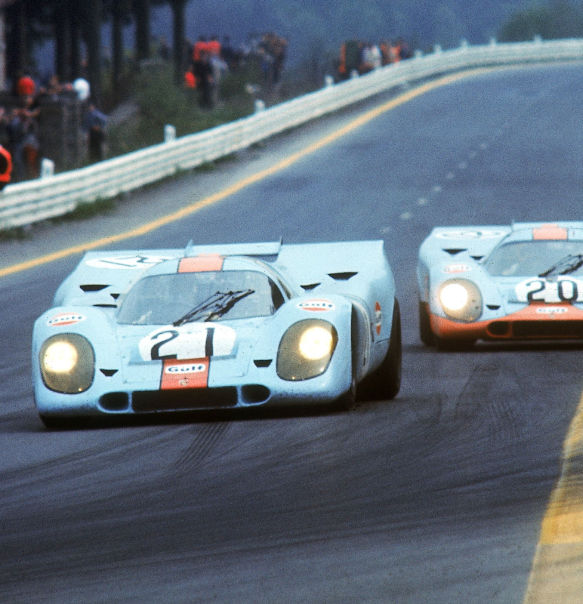
This stability problem wasn’t resolved until Porsche partnered up with John Wyer and his automotive group. Porsche would continue to develop engines but J.W. Automotive would enter and race the cars. They were the ones who eventually solved the aerodynamic problems and created the 917 body style we know and love today.
No doubt when Enzo Ferrari was told what the early 917 could do, he knew that this was a serious threat to Ferrari’s chances of winning any more World Sportscar Championships. So Enzo, now flush with needed capital from selling half his stock to Fiat, shut down development on the 312P program to concentrate on creating a car that could equal or beat the new 917. In a remarkable nine months the Ferrari 512S made its racing debut at the 1970 24 Hours of Daytona. Author’s Note: When Porsche’s Dr. Ferdinand Piech brought in the FIA homologation inspectors to try and get the 917 certified he had only 18 completed cars and the parts for the remaining 25 on the factory floor. The inspectors gave a thumbs down on certification saying that all 25 cars had to be assembled and ready to drive. Yet, one year later Enzo Ferrari had only 17 cars assembled with five of them already in Daytona for the 24 hour race. Despite only having 17 cars fully assembled the FIA inspectors granted homologation for the 512. This homologation came when the Daytona race was already seven hours old. Makes you think, doesn’t it?
Unfortunately the six month lead that Porsche had in development and testing was too much of a handicap for Ferrari. Porsche won nine of the last twelve endurance races (as of January 1971) and the manufacturer’s title in 1969 and 1970. During the 1970 season the FIA, trying to close that loophole that allowed the birth of the 917 & 512, changed the rules again. They mandated that “all” Group 5 sportscars (917’s, 512’s and so on) would be limited to a maximum of 3-liters for the 1972 season. This would effectively retire those wonderful cars from any more FIA events after only 2 ½ years. The series name was also changed from the World Sportscar Championship to the World Championship of Makes.
Since 1971 was going to be the last year for the 5-liter sports cars, Enzo Ferrari felt he didn’t have the resources to support a 512 factory effort in the 1971 season. He would leave it up to private entries like Luigi Chinetti and his North American Racing Team (N.A.R.T.) and Roger Penske to represent Maranello while Ferrari continued to develop his 3-liter car for the 1972 season.
The Tony Adamowicz – Ronnie Bucknum Ferrari 512S Spyder of the North American Racing Team. The North American Racing Team (NART) Ferrari 312P/71 of Luigi Chinetti, Jr., Nestor Garcia-Veiga and Alain De Cadenet.
Porsche took the opposite view. They continued to help J.W. Automotive and their other defacto factory team (Martini International Racing Team) and didn’t even consider developing a 3-liter engine for the 1972 season. Instead they quietly decided to withdraw from the World Championship of Makes and enter their 917 cars in the very popular American Can-Am Championship.
So, in January of 1971, at Daytona there were technically no factory teams. We have the Porsche factory-supported Gulf and Martini Porsches, the Ferrari-supported NART and Penske Ferraris as the main competition. Alfa and Matra were absent from this event, Matra mostly because of the horrendous and embarrassing accident that occurred at Buenos Aires earlier in the month that took the life of Ferrari favorite, Ignazio Giunti.
Giunti was driving the new factory Ferrari 312PB when he plowed into the Matra 660 of Jean-Pierre Beltoise. Beltoise had run out of gas a quarter mile from the pits. For some unknown reason he decided to push the car (a disqualifying offense) to his pit. At one point he was literally in the middle of the track. At that particular moment Beltoise looked over his shoulder and saw two cars coming toward him and barely got clear of his car when Giunti, his view blocked by the slower car in front of him, tried to pass and struck the Matra. The impact at full speed and resulting fire gave Giunti little chance of survival.
After the race Enzo Ferrari announced, that in honor of Giunti’s memory, they would not race any factory cars at the Daytona event which was the first points race of the season. Some automotive writers scoffed at this saying that Porsche humiliated Ferrari in 1970 and Enzo was just looking for an excuse not to be beaten again.
Martini & Rossi Porsche racing team at the 1971 24 Hours of Daytona.Martini & Rossi Porsche 917K of Helmut Marko and Rudi Lins.The Ferrari 512M of Masten Gregory and Gregg Young in the pits prior to the start of the race. The car failed to finish.
The 917 Porsches were a known quantity since they had been regular winners the past season but the dark blue and yellow Penske/Kirk F. White/Sunoco Ferrari 512M was something new and a remarkable piece of fabrication by the Penske boys back in Philadelphia.
Penske literally took a Ferrari 512S and rebuilt it from the ground up adding on the more aerodynamic “M” body. The new body made it look more like a 917 than a 512 and for all intents and purposes, it was a brand new car. Again, the FIA didn’t see it that way and approved the new body without much fuss. Enzo must have known someone who knew someone at FIA.
Added to the aerodynamic improvements Penske got TRACO to boost engine power by 35 horses to an impressive 640 hp. With a new wiring configuration plus a whole host of other improvements the car could have been a serious contender for the 1971 manufacturer’s championship if the Ferrari factory had adopted the Penske improvements or contracted with Penske to build a version of the 512M.
While a J.W. Automotive Gulf 917 had won Daytona the previous year John Wyer was no lover of this particular race. According to Wyer, “The (Daytona) race should be shorter than 24 hours so we could have a motor race instead of having to conserve cars.” Having spent several cold January nights on the track as a corner worker doing the midnight shift I wouldn’t disagree with that point of view. Shorter might be better.
The 61-year-old Englishman also vented his feelings concerning the changing nature of racing back in 1971, saying, “Racing…is still a sport but includes more business.” Ironically it was his wildly successful cars that contributed to the evolution of endurance racing into what it is today…big business.
Lost in all the hub bub about 917’s and 512’s in 1971 were the cars that made up almost two-thirds of the 65 cars that were supposed to fill up the starting grid. They were the touring and grand touring cars, many of which were entered by weekend racers who might enter one or two big events a year like Daytona and Sebring. Many of these privateers raced on limited budgets with many camping out in the infield and cooking their meals over an hibachi.
John Greenwood stands next to his Chevrolet Corvette that he co-drove with Allan Barker and Dick Lang.Ferrari 512S of Arturo Merzario and Jose Juncadella.Chevron B16 of Clive Baker, Sam Brown, Bob Grossman and Charles Reynolds.
Unfortunately quite a few of these small-time racers got shafted that year at Daytona when the FIA trimmed the starting field from the previously announced 65 cars to 48.
Cars that qualified slower than 93 miles per hour over the 3.81 mile course were judged as too slow and withdrawn from the race (no idea if their entry fee was refunded.) The rationale behind this unexpected last-minute decision was the speed differential that could reach over 100 mph between the fastest and slowest cars.
This danger was especially acute at night on the high banks where line of site is shortened by the curve of the banks plus a closing speed that left little chance for evasion. As they told the slower drivers at the driver’s meeting, “Stay in your lane on the high banks. You don’t want to get a Porsche (917) enema.”
1971 24 Hours of Daytona – The Start
The weather for the start of the race at 3 p.m. on Saturday, January 31, 1971 was an unusually warm 78 degrees. As expected the Penske Ferrari 512M, driven by Mark Donohue and David Hobbs, pulled away from the field when the green flag dropped followed by the two J.W./Gulf Porsche 917Ks driven by Pedro Rodriguez, Jackie Oliver, Jo Siffert and Derek Bell.
The Penske Ferrari set a blistering pace with one lap in excess of 135 mph and they held the lead for two hours and forty minutes until electrical problems forced them to pit twice, once for a broken alternator wire and the second time when the car was black flagged for no tail lights. These stops cost them four laps and by 6 p.m. they were in third place behind the two Gulf Porsches, one of which (Rodriguez-Oliver) had lapped the entire field save their other team car.
At 6:01 p.m. the second place 917K driven by Derek Bell blew its engine and the car retired after limping into the pits in a cloud of oil smoke. Succumbing to another blown engine 90 minutes later was the fifth-place Belgium-entered Ferrari 512S of Hughes de Fierlant and Gustave Gosselin. At 9 p.m. the Rodriguez-Oliver Porsche 917K was first, second was the Vic Elford – Gijs van Lennep Martini and Rossi 917K with the Donohue – Hobbs Ferrari third. Moving up to fourth position was the Tony Adamowicz – Ronnie Bucknum Ferrari 512S.
At the start of the race the Ferrari 512M of Mark Donohue and David Hobbs set a blistering pace.Pedro Rodriguez in the #2 Porsche 917K and Jo Siffert in the #1 Porsche 917K were second and third behind Mark Donohue’s Ferrari 512M early in the race.Jo Siffert / Derek Bell Gulf Porsche 917K retired early with a blown engine.
Tony Adamowicz in his NART Ferrari 512S leads Luigi Chinetti, Jr. in his NART Ferrari 312P.Martini & Rossi Porsche 917K of Helmut Marko and Rudi Lins. The car was a DNF due to an accident.Belgium-entered Ferrari 512S of Hughes de Fierlant and Gustave Gosselin was a DNF due to a blown engine.Ferrari 512S of Arturo Merzario and Jose Juncadella in for a regular pit stop. They failed to finish.Jo Siffert’s Porsche 917K passing the Ferrari 512S of Tony Adamowicz.As the sun began to set the Rodriguez / Oliver Porsche 917K had already lapped the entire field.
Right before midnight, 11:48 p.m. to be exact, Vic Elford, in his silver Martini 917, was doing over 190 m.p.h. on the 31 degree east bank near the track tunnel when his right rear tire blew. His car hit the wall, spun down to the grass then back up the banked track to hit the wall again, finally rolling down to the apron. Seconds later the third place Penske 512M, being driven by Mark Donohue, entered the scene and he slowed because of the cloud of dust thrown up by the accident. Right behind Donohue, but not slowing, was the Porsche 911S of Charles Perry and he gave the Donohue car a mighty wallop shoving it into the wall and causing major body and suspension damage.
Perry’s car then spun down to the apron where he hit the disabled 917K of Vic Elford totally demolishing it. The 911S rolled eight times before coming to rest. Fortunately Elford had exited his car just seconds before and was OK. Perry had to be transported to Halifax Hospital in Daytona for x-rays. Later, while looking at what was left of his car sitting in the track garage Elford said, “I’m glad to be alive.”
Donohue, uninjured in the melee, managed to get his car onto pit lane and back to the Penske pits. After a quick evaluation of the damage the Penske crew broke out a case of duct tape and proceeded to tape the car’s body back together and replace damaged suspension parts. This took one hour and 15 minutes. Within minutes of reentering the race, the talk on each corner was of the “duct tape special.”
Before this accident happened the Rodriguez – Oliver 917 had continued to rack up the miles and extend their lead. After nine hours of driving they were averaging 124.285 m.p.h. and had a 30-mile lead over the ill-fated 917 driven by Vic Elford.
As the midnight hour struck the Rodriguez 917 was still in first, the Bucknum N.A.R.T. Ferrari 512S was second, Luigi Chinetti, Jr. was third in a Ferrari 312P, Mark Donohue’s Ferrari 512M was fourth (but in for repairs) and the Owens Corning Corvette of Tony De Lorenzo was now fifth.
The Vic Elford/Gijs van Lennep Porsche 917K was forced to retire after Elford blew a tire at 190 mph on the high banks and hit the wall.This is all that is left of the Vic Elford / Gijs van Lennep Martini Porsche 917K after Elford blew a tire on the high banks at 190 mph.Mark Donohue / David Hobbs Ferrari 512M shows the damage caused by the three car accident when Vic Elford blew a tire on the high banks. That accident probably cost the Penske/Donohue team the win.It took several rolls of duct tape to put the damaged body back together. Despite all these problems they managed to finish third.
1971 24 Hours of Daytona – Day Break
As the sun began to break over Daytona Beach a brief rain shower hit the speedway causing misery for the corner workers and dangerously slick driving for the 25 cars still in the race.
The repaired Ferrari 512M of Mark Donohue and David Hobbs was trying to make up for lost time but had to pit for rain tires after spinning twice on the slick track. The 512M had passed the Chinetti – Veiga Ferrari 312P to regain third place and they were gaining on the second place Bucknum – Adamowicz Ferrari 512S.
Bucknum and Adamowicz were putting on quite a show with a car that seemed to be ailing. Every time the car came into a corner it belched flames from the exhaust. Later Adamowicz would say that Bucknum broke some valve springs running RPM’s that were too high. This caused the car to misfire and belch flames. To preserve the car for the finish they had to abandon any attempt at keeping up with the 917’s and, as later events would show, lose any chance of winning.
At 9 a.m. the Rodriguez – Oliver 917 was first, Bucknum – Adamowicz 512 was second, Donohue – Hobbs 512M third, Chinetti – Veiga 312P fourth and the Delorenzo – Yenko Corvette fifth.
After 21 hours of driving another J.W./Gulf Porsche 917 victory at Daytona seemed assured. Rodriguez and Oliver had what everyone thought to be an insurmountable lead of 213 miles over the second place car.
Obviously Ronnie Bucknum lost something on the race course. Despite this problem he and Tony Adamowicz finished second.Stephen Behr, John Buffum and Erwin Kremer drove this Porsche 914/6 to 8th place.Early Sunday morning the Baker/Grossman/Reynolds Chevron B16 showing the wear of the 24 hour grind.An unflattering view of David Yorke (blue shirt) as he gets the Gulf Porsche 917K of Pedro Rodriguez and Jackie Oliver lined up in the pit box. David Yorke (far left) directing the pit operation and coming into the picture on the far right is the great racing mechanic Ermanno Cuoghi whom some say was the best racing mechanic ever.The Ralph Meaney, Bill Bean, Gary Wright Porsche 914/6. The car failed to finish.The Owens Corning Corvette of Tony DeLorenzo and Don Yenko came in 4th.Porsche 911S of Ray Walle and Michael Sherwin finished 14th.Sunday morning with just a few hours left and the Gulf Porsche 917K and Ferrari 512S enter the high banks from the infield at Daytona. They pass the seventeenth place finishing MGB GT of Jim Gammon, Dean Donley and Carlos Garza. The Penske Ferrari 512M follows the three onto the high banks.Chevron B16 of Jean-Pierre Hanrioud and Jean Sage leads the Chevron B16 of Clive Baker, Sam Brown, Bob Grossman and Charles Reynolds onto the high banks. The cars finished 15th and 12th, respectively.The Arturo Merzario/Jose Juncadella Ferrari 512S coming into turn three. They were a DNF due to a faulty fuel pump.Don Yenko gives a thank-you wave to John Buffum as they approach turn three at Daytona.
1971 24 Hours of Daytona – The Finish
As many were going to lunch Jackie Oliver brought in the leading car ahead of schedule. Somewhere on the high banks the transmission on his 917 crapped out and he coasted down pit lane to the Gulf pits with the transmission stuck in high gear.
Under normal circumstances this would be a simple repair because they had plenty of time. Just swap out the damaged transmission for a working one. However FIA rules didn’t allow this. You had to fix the damaged transmission, but was there enough time to do so?
John Wyer decided to go for it and the Porsche mechanics bent to a task that many, who were witness to it (including me), thought was impossible, totally rebuild the transmission one gear at a time in less than two hours.
Three hours before the end of the race, and with a huge lead, Jackie Oliver brings his Porsche in with a busted gearbox. Porsche mechanics work feverishly to rebuild the transmission.Jackie Oliver waiting patiently for the transmission repairs to be completed on his Gulf Wyer Porsche 917K.
As if this drama at the Speedway wasn’t enough, something happened outside the track that brought everyone in the grandstands to their feet in shock and horror.
At the Daytona International Airport, adjacent to the Speedway, a private plane had just taken off and at about 100 feet off the tarmac lost power, stalled and nose dived into the ground producing a huge ball of flaming black smoke. It took the airport crews over 15 minutes to douse the flames and the occupants were burned beyond recognition.
Back at the Speedway the Porsche mechanics were working feverishly to make the transmission repairs as the Bucknum – Adamowicz Ferrari 512S steadily chipped away at their lead. From the pit enclosure Rodriguez and Oliver watch, mostly in silence. They were both exhausted because, like most drivers, neither had slept since Friday night but they were both alert and ready to race.
After what seemed an interminable 92 minutes the car was ready to reenter the race. The time was now 1:05 p.m. with just under two hours left to go. However, they had lost their huge lead and were now second behind the Bucknum – Adamowicz Ferrari by almost three laps with the Donohue – Hobbs Ferrari coming up fast in third place just two laps behind the Porsche.
Ronnie Bucknum leaves the pits in an attempt to chip away at the lead the Rodriguez and Oliver have while the Porsche is in for repairs.While the Rodriguez/Oliver Porsche 917 is in the pits for repairs the Ferrari 512S of Adamowicz/Bucknum takes the lead. However their car is ailing with broken valve springs.
The “little Mexican” Pedro Rodriguez was tasked with regaining that lead and since the Porsche 917K (when healthy) was 10 to 12 seconds a lap faster than the ailing Ferrari 512S it seemed possible, and it was. In a brilliant feat of “balls-to-the-wall” driving, Rodriguez regained the lead in a remarkably short 33 minutes.
What followed then were two unscheduled pit stops for Porsche, both for tires. A brief rain shower forced the Porsche to pit for rain tires. It was over quickly and when the track dried sufficiently they pitted again for slicks. During one of those stops they lost the lead to the Bucknum – Adamowicz Ferrari which stayed out the entire time on slicks.
When Rodriguez took the checked flag at 3 p.m. he was ahead of the Bucknum – Adamowicz Ferrari by just over one lap. This was the closest finish at the Daytona 24 in the history of the event up to that time.
After 92 minutes for repairs Pedro Rodriguez takes the Porsche out to reclaim the lead. However, brief rain showers makes driving dangerous as he goes for the leading car.Despite the blue smoke coming from a cracked tail pipe it only took 33 minutes for Rodriguez to reclaim the lead and go on for the win just one lap ahead of the second place Ferrari. An amazing drive by ‘The Little Mexican’.The Adamowicz/Bucknum NART Ferrari 512S manages to hold on to second place. This was the closest finish in the history of the Daytona 24 up to that time.The Donohue/Hobbs Penske Ferrari 512M crosses the finish line in third place with the Adamowicz/Bucknum Ferrari coming in second and the Greenwood/Barker Corvette coming in 10th.Luigi Chinetti, Jr., Nestor Garcia-Veiga and Alain De Cadenet drove this Ferrari 312P to 5th place and 1st in class.These three cars finished 1-2-3. The #2 Porsche 917K of Pedro Rodriguez and Jackie Oliver finished first. The #23 red Ferrari 512S of Tony Adamowicz and Ronnie Bucknum finished second and the blue #6 Penske Ferrari 512M finished third driven by Mark Donohue and David Hobbs.Oliver met Rodriguez up the pit lane and hopped in to the car to drive it to the winner’s circle. Rodriguez got cleaned up and into an orange Gulf jacket to ride on top of the car. That is him waving to the crowd.The Winner’s Circle at Daytona. Pedro Rodriguez and Jackie Oliver flanked by Miss Universe (on left) and Miss Speedweeks (on right).
The Rodriguez – Oliver Porsche 917K averaged 109.203 m.p.h. and covered 2,621 miles making it the second fastest Daytona 24 up to that time.
For their efforts the JW/Gulf Porsche team was awarded $17,000 of the $55,000 total purse for the event. Bucknum – Adamowicz got $6,800 for second place, Donohue and Hobbs got $3,700 for third place, DeLorenzo and Yenko got $1,400 for fourth and Chinetti and Veiga got $500 for coming in fifth.
The nail-biting drama that occurred during those last three hours saved the race from becoming a boring runaway by Porsche and turned it into a contest worthy of remembering. Despite the fact that there were no “factory” teams entered at Daytona in 1971, the 24 Hours of Daytona was full excitement and drama worthy of any international event. Unfortunately it was also the last time the very popular, and now legendary, 917s and 512s would race competitively at Daytona. It was the end of an era.
[Source: Louis Galanos]
No Subscription? You’re missing out
Get immediate ad-free access to all our premium content.