Interview and photos by Dennis Gray (unless noted) On Tuesday between the Pre-Reunion and the Rolex Monterey Motorsports Reunion, Cris Vandagriff, Historic Motor Sports Association (HMSA) President, agreed to sit down for an interview with Sports Car Digest. I knew a little about Cris, mainly that he had grown up around his father’s import car dealership, Hollywood Sports Cars. He knew and was friends with Pedro Rodriguez, Peter Revson, Jerry Titus, Phil Hill, Richie Ginther, Dan Gurney and numerous other heroes of the ’50s, ’60s and ’70s U.S. and European sports car racing scene. Cris ran Hollywood Sports Cars and Ferrari of Beverly Hills in the ’80s and ’90s.
In 2010, his group HMSA inherited the mantle of the top historic race sanctioning body in the U.S. when they took over organization of the Rolex Monterey Motorsports Reunion and the previous weekend’s Pre-Reunion events. Cris’ history with these cars when they ran in period, and his understanding of how dangerous they are, gives his views of the events, cars and drivers on the historic race grids of today a unique perspective. Sports Car Digest: Can we begin with a short history of Cris Vandagriff? Cris Vandagriff: I am Southern California born and raised. Went to USC. I have been involved with cars my entire life. Years before I was ever born my family was involved in motorsports. My great grandfather was a riding mechanic at Indianapolis. My father was very involved in the formation of the Can-Am and Trans-Am series. One of my father’s running mates in life was Jim Kaser, who is actually the father of the Can-Am. My father helped Jim put that series together. We participated in the Can-Am series from 1966 to 1972. I started traveling with the team in 1968, the year Jerry Titus drove for us in a McLaren M6B. In ’69 Ferrari loaned us the 612 Ferrari. Chris Amon was a Ferrari factory Formula One driver and drove the car for us. We bought the car back and ran it in ’70, ’71 and ’72 with Jim Adams driving.
Pedro Rodriguez and my dad were basically like brothers, and when Pedro was killed, my dad wouldn’t go to any more races. I still had the burning desire to drive racecars. When we were on the Can-Am circuit, Peter Revson and my dad were friends, and he would come out to the track and come up to me and put $20 in my pocket and say, ”Here, the old man said to be sure you have some money.” When Peter was killed in ’74 was when I walked away. These guys dying didn’t make sense; it’s too difficult losing friends. They were my heroes at that time, and I was young and they are all getting killed. Dad and I basically walked away from motorsports; we were heavily involved in it all through the ’60s and ’70s.
My driving career started in 1973 with a driving school. I would go off racing friends’ cars and my parents didn’t know at the time. When they did find out about my racing, stuff hit the fan pretty badly. I was going to be excommunicated out of the business if I did not stop, which I did. I basically stayed away from it until about 1981. A friend bought a Corvette racecar and wanted to go vintage racing. He asked me to accompany him to Willow Springs, and that started my vintage racing. I got heavily involved in it, leading to huge fights with my dad about my driving. I finally got him to come to a race to watch me and the other competitors drive, once he saw us all on track he was OK with it.
Somewhere around 1988, I was a member of VARA, a vintage racing organization, and vintage racing with VARA. They asked me to become their driving instructor. From driving instructor I went to their Board of Directors. I was on the VARA board for quite a few years.
While all this was going on in the background, my family owned Hollywood Sport Cars. We were the oldest Ferrari dealer in the United States and the second largest in the world. I started running the dealership in ’81 and ran it until 1993. In 1993 I took a position with Ferrari North America and established Ferrari Beverly Hills for the Ferrari factory.
By 1995 I was running three race teams and the Ferrari dealership. Running a quasi-factory BMW race team for BMW, running the Ferrari Challenge Series with seven cars, and running a Ferrari 333SP with Didier Theys driving for us in the IMSA series. My life was absolutely wacky. By the end of 1995 I was totally burned out. I thought it was time to take a break. I had never taken a vacation in my professional career, and wanted to take some time off. Instead I ended up running VARA. I ran VARA five or six years until I wanted to leave VARA to start my own vintage organization.
I had known Steve Earle my whole life, I called Steve and he immediately said, “Don’t go do your own thing, come work with me and I’ll sell you HMSA and you run the HMSA stuff and the General Racing stuff. Coincidently, my dad started General Racing and Steve Earle was the backer behind General Racing. Last year, mid-year Steve and I had a parting of the ways. HMSA was growing quite a bit at that point, and hopefully it will continue to grow, Steve was having some issues with different events and General Racing was getting smaller. We just went in different directions.
When General Racing and Laguna Seca had a parting of the ways, Laguna Seca asked for a proposal from me to run what was the Monterey Historics and now is the Rolex Monterey Motorsports Reunion, and that brings us to today and how I got to the position I’m in. SCD: Where do you see the Rolex Monterey Motorsports Reunion going? CV: I saw this event, the August historic races at Laguna Seca, as a diamond in the rough. We had given some proposals to Steve and ideas to the track years ago about turning this into a Monterey speed week in August, where we start with the Pre-Historics now the Pre-Reunion and we go all the way through to Saturday of the Reunion, go back to the way we had been in the past, quiet on Sunday, so we don’t compete head to head with Pebble Beach. It’s a two-week car fest. I still think this event is a diamond in the rough. It’s growing a bunch. The future is bright for this event. Obviously, this is car heaven on the Peninsula this time of year. It’s interesting, when I had the dealership in Southern California, Beverly Hills was shut down because there were no cool cars on the street they were all up here. Our service department was just swamped in the end of July and the first of August for guys getting their cars ready to bring up here. It’s a mass exodus, I’m sure the San Francisco Bay Area is the same way. SCD: Do you work with any of the shows such as Pebble Beach or Quail? CV: As far as me working with Pebble Beach or the shows, I don’t have any contact with them at all. I can’t speak for the racetrack and what their involvement has been. I know that there has been some dialogue, but I am dealing primarily with race operations and on-track activities. I don’t need to go put my finger into anything else. SCD: How does someone get started in HMSA racing? CV: It’s interesting; I think that because I’m from Los Angeles, Long Beach Grand Prix is an easy example. A couple sits in the grandstands and watch the Long Beach Grand Prix, the husband and wife will sit there and the wife would never say to her husband: “Honey, you could do that.” Or, for that matter, the husband says to his wife: “Honey, you could do that.” They come here to Mazda Raceway Laguna Seca and easily the wife and husband could sit there and say to each other: “Honey, we can do this.” The spectators are walking through the paddock with their sons and daughters or grandchildren, pointing out the cars we all grew up with, and I think it’s easy for that spectator to see somebody their own age, competing and jumping in and saying, “How do I do this?”
I always encourage people to come out to the races, not only the spectator races, but club events, choose a car that they like. Do not choose it because you think it’s going to go up in value, I don’t care if it’s a bug-eye Sprite or a Can-Am car or a Ferrari. Buy the car that you like first, go to driving school. The driving schools often scare me because they teach you how to race, and we don’t encourage racing the way the SCCA or IMSA encourages you to race. This is more of an exhibition of sharing your car with others. That’s not to say that drivers aren’t out there racing as hard as they can, but we have to be respectful of the cars, our cars. Our era of cars is the era when guys got hurt, killed. They aren’t the safest cars, and the demographic of our customer is pretty high end. So, they’ve got some big responsibilities. “I always say the water’s warm, come on in, jump in”.
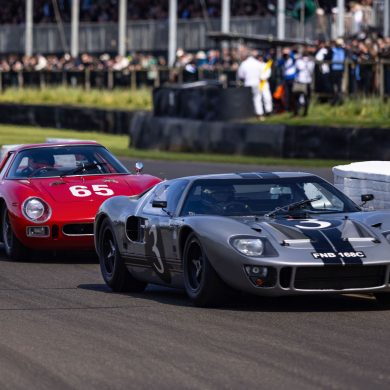
SCD: What are the criteria for getting a car accepted into the Rolex Monterey Motorsports Reunion? CV: The first qualifier is its race history. Let’s say you have a Porsche Speedster that was just a street car and you converted it, versus a Porsche Speedster that has been a racecar since the ’50s. The racecar since the ’50s is going to be accepted all day long, and we don’t necessarily accept it on its condition, or how close to a concours car it is. I prefer a car that has patina and has raced its whole life. Kenny Epsman is a great example. He’s got a Torino and a Monza. The Torino is absolutely original. Kenny’s Monza is absolutely original, has never been repainted, the paint isn’t the best, but it’s original. I look at it and say it is one of the best cars out here. It’s like Pebble Beach, Pebble has cars that have been restored beyond their wildest imaginations and then they have original cars. So those are the first two qualifiers. Then you have a bunch of cars, several cars that are similar, several cars have race history to some degree. Then you have to take the cream of the crop. Obviously we are going to take the cars with the best history. We’re really fortunate with this event we really get the cream of the crop with the cars. This year’s Pre-Reunion was just phenomenal, the quality of cars we got; and the Rolex event as well. In 2004 when we featured Ferrari, we had 27 of the 36 250 GTOs. I’ll never forget watching those cars come down out of Turn Nine and looking at Steve Earl and saying, “Who’s going to call the insurance company on this thing? Not me.” It’s never happened before. To think of those cars being worth $25 to $30 million dollars today and then being on the race course is pretty staggering. SCD: What are the criteria for getting a driver accepted into the Rolex Monterey Motorsports Reunion? CV: Basically all the drivers are accepted, unless they have a history of having problems. Often times, professional drivers don’t have a good mentality for historic racing, and what has been explained to me is that they were always paid to go out and win races, be at the front of the grid and win at all costs. And often, professional drivers, retired drivers, don’t have the mentality to back off and let someone else have the corner. The biggest thing is we want safe drivers. We have fabulous, phenomenal cars, and our participants are high-profile guys, but I don’t care if he is a high-profile guy, selling bread or if he is the CEO of some Fortune 500 company. They are still important and the safety of the participant is paramount with us. Obviously, if a driver isn’t being safe we take him off the track. Our philosophy of having no tolerance for contact is unique in the country. Everybody, all the vintage organizations, has that policy, but not very often do vintage organizations put guys on a trailer for hurting their car. Our view is that if you do damage to your car or someone else’s car, you are excused for 12 months. No discussion. That allows us to get truly the premium cars, the quality cars. SCD: Are you going to extend the Rolex Reunion to Monday, Tuesday and Wednesday following the Pre-Reunion? CV: That’s not my call, that’s Barry Toepke’s call. We have expanded it this year (2010) to include Thursday. I don’t know if we would go beyond that. I see us kind of joining the Pre-Reunion and the Reunion closer together, but not necessarily racing on Monday, Tuesday, Wednesday, but more on-track activities. I don’t see us expanding the on-track racing. One of the things we have to be sensitive to is that these cars are sensitive, and they’re old cars, and they break. We are not trying to wear them out. SCD: Do you think 600 cars is the maximum you can do in three days? Would you like to have more cars, or do you want to cut it back? CV: The size of the paddock really dictates the amount of cars we can take. The track has expanded the size of the grids, this year to a maximum of 40. In the past, this event has had a similar number of cars. Trans-Am cars are a perfect example. I’ll never forget one year we had 45 Trans-Am cars. Again, you look at Trans-Am cars and they are all documented racecars. If there are 45 of them, and you’re trying to pick the cream of the crop, an owner has a documented race history car, and then we tell them they can’t run this year because there is no room. It’s difficult, paddock-wise, facility-wise; 600 is really a lot of cars. If we could get our participants to look at what Goodwood does as an example, where you are invited to participate with your car and bring basically a fishing tackle box for tools, then 600 cars would not be a problem. Unfortunately, that’s not the American philosophy. It would be nice if we could have the resources to build covers like they do at Goodwood so that the cars are protected, or tent the facility and just say flatly, no one comes in with a transporter, no one comes in with a trailer or support vehicle. Then we could be successful at getting 600 cars. It is really a difficult task. For the first time this year the event is not allowing regular street cars into the paddock. I’ve always said that the paddock is part of the race weekend show, so we want the guys to have a nice paddock display. Have the cars in the front being displayed prominently. I’ve asked guys to do story boards because that‘s all about the story. We don’t want to showcase a Ford Taurus. Sorry Mr. Ford, but that’s not going to happen. We say if you have a neat car, if you have an Monza Ferrari, yes, that‘s something of interest to the participants. We can help enhance the show by taking out the Taurus and the Lexus cars, and putting in what Gill Campbell terms the cool cars. SCD: With many of the cars on track selling for multiples of millions, do you find this affects the racing? CV: I have an off-the-wall philosophy about that. I say the more expensive the car, the easier it is to race. I think, with the philosophy that we promote for our events of no contact, we are very restrictive with the drivers and the cars being safe. Arrogantly speaking, the cars that we get out here do not run the East Coast events. A lot of these cars come from the East Coast; they won’t put their cars in harm’s way. We have been able to get away with promoting the philosophy that this is a non-contact sport. Hence we get the great cars. I think that guys are very careful with million-dollar cars, and they usually have professional guys looking after them and are careful with them. They are prepared well and have very few mechanical problems. So, I think the more expensive the car, the easier it is to race. SCD: Do you own any vintage or historical cars? CV: I don’t anymore. I’ve been really fortunate to own just about everything I’ve wanted. I don’t have the mentality to run a race event and to run a car. I’m at the racetrack 15 weekends a year, and I have a son in high school trying to get to college. So, I don’t have a problem sitting on the sideline right now. Like I said, I got my license in 1973, so I’ve been able to do this for a really long time. All through the ’80s I was running three events a month. Some were around the country and I was really fortunate enough to spend a fortune. I will never forget my sister, she was the bookkeeper at the dealership, coming to me at the end of one year and asking, “Do you realize how much money you spend?” I said never add that budget up again. Again, things and circumstances change. I don’t have the money to do those things I did in the past. My last car was an Alfa GTV that had been sitting for years, and I figured that by the time I would want to run it again I would have to restore it. So it was OK to let it go and let somebody else enjoy it. In the mid ’80s I was on a mission to collect all our family’s racecars, and I did OK with that. Then I got to the point where I was fighting my dad about driving the big cars, so I sold them and they went to great keepers of the flame. And they are out still there. I recently found one of our most successful cars, which was an MGB that Ronnie Bucknum drove for us. Honda took Ronnie Bucknum out of our MGB and put him directly into the Honda Formula One car. SCD: Which one car interests you most? CV: If I could have any car in the paddock, I would have a GT40. I spent a lot of time running 40s, absolutely love them. It’s similar to a Can-Am car, just easier to drive. With the Can-Am cars I was never comfortable driving at my limit of ability. With the GT40 I was able to run very competitively. I thought I could drive them well and was close to probably 8/10ths of what the car was capable of. But I was lucky enough not to be at the back of the pack, and was often times at the front. The GT40 is a great car, a phenomenal car.
SCD: How many full-time staff do you have? CV: For our Portland race, we have basically three people full-time who concentrate on Portland and help with Coronado. We just brought Tiffany Koss on board who is going to help us with marketing, and basically business development, new venues. There is some stuff coming online that she is going to help with. SCD: Can you talk about new venues? Are you going East? CV: Far East is that way (Cris points West across the Pacific). We’re not going to the Far East. We’ve have had some discussions with Ray Holland (Hardcore Performance, Saskatoon, Saskatchewan, Canada). It’s an interesting company. He’s going to some great venues. Barber Motorsports Park is the finest motor park in the country. I look at it and say our HMSA members should be exposed to that facility, it’s phenomenal. St. Jovite Mont Tremblant is my favorite spot in the world—unbelievable racetrack, great city, great area, great people. One of the venues that we had been trying to develop, but that has had a stutter step, is Reno Fernley Raceway. It fell into some really drastic times this past year and closed. The lenders have taken it over and committed to spend money on it, and to finish the racetrack. Reno Fernley Raceway has potential to be a really great racetrack. I’m really high on Reno. It’s a great car town, you have Hot August Nights, with like a million people. Reno Fernley Raceway is a new venue that we want to continue to develop. We were on a great roll with it doing the historic races, involved with the city and having a parade in downtown. The mayor loved it. Were involved with the National Automobile Museum, what’s left of the Harrah’s collection. That’s huge, and I think the National Automobile Museum needs to have a presence within our little world. SCD: How do you extend the demographics with these ticket prices into a younger crowd? CV: Bless you. That’s probably the million-dollar question. This year having the stock cars will help that somewhat. Because this is a fairly expensive spectator ticket, you’re not going to get a 16-year-old coming to this event by himself. We hope that he is going to come with his family or his father, and hope his Dad will turn him on to a great car and expand it that way. As far as participants, really push the idea of mentoring. For our April club event we had 10 participants who were mentoring 10 young drivers, which I was excited about. Several of them were family members, and there were several of them friends and neighbors who liked the cars and wanted to come along. I’ve encouraged our participants, if they’re getting to a certain age, that if they don’t want to drive anymore, to put it in a different perspective, put someone in it to drive it and you can still come along to the races. That way they remain the entrant, and they can enjoy watching the car and watch someone else drive it. The biggest, toughest part is lowering the spectator demographic age. SCD: To draw the younger spectator, what about a current or even “vintage” NASCAR driver who will show up and drive? CV: Show up and drive. I’m not necessarily a big fan of either current drivers or period drivers participating in our events. Several years ago HMSA put on an event in conjunction with Long Beach Grand Prix where we had a group of vintage Formula One cars come and one of the drivers had a health issue and couldn’t drive. They asked for Alex Gurney to drive the car. Alex was in between rides, it was after his Atlantic stint and before the Grand-Am drive came about, and I said no, I don’t want Alex to drive the car. It’s a little bit arrogant of me, and I didn’t want to play God. The participant didn’t think about it the way I had approached it. I said, “Look, Alex is a professional racecar driver, he is a young driver and he deserves a great ride. He is going to have to get into a car and go as fast as he can and just decimate the rest of the field, which is not what we want.” If he doesn’t do that, just goes and drives and plays in the middle of the pack, then he runs the risk of people saying his career is history that he is washed up. That would have been really bad for him, and nobody had thought of it from that perspective. When I told the owner my thoughts on it, he agreed with me. Likewise, the next candidate was Al Unser Jr. and I said, “No, the same thing applies.” Everybody is going to say that Al Unser Jr. has to be at the front of the grid. If he is not at the front of the grid then people are going to look at him and say he is really washed up. So that’s one aspect of it, the idea of putting a current driver into a car. I look at it like our events are for our participants to share their cars with other people. Not necessarily for Jeff Gordon to come here and jump into a car and race it during the event. Dario Franchitti is going to be here this weekend driving some cars. He’s a huge Jimmy Clark fanatic and fan, as you would expect being from Scotland. He’s going to do some demonstrational laps, and that’s what I like to see. I love for our events to be welcoming to period drivers and to current drivers. But for the fans to see those guys outside of the car shaking hands, getting an autograph, versus them being in a race car. They can see that almost every Sunday on television. SCD: What is the biggest problem facing historic/vintage racing in America right now? CV: Vintage racing or historic racing? Our company is called Historic Motor Sports Association, and we hope to attract cars with history, cars that ran in period, versus vintage being an old car that has been turned into a racecar, that’s the difference. The biggest difference in going along with that is the cars are prepared as they were in period, not as they could have been. It’s not our philosophy to do that. The development of the cars for us, with production-based cars, stops in 1966. Lots of technology exists today to make the cars run a lot faster than they did. We have no interest in that. We are preserving history. I always say, “The Mona Lisa is not a very attractive woman. I could probably make her, with a couple of brush strokes, more attractive, for me.” That’s sacrilege. People would go nuts if I even suggest that, but often people don’t even think about the idea of putting non-period brakes on their Shelby. You just took the paint brush out and started fixing the Mona Lisa. People say this car’s scary to drive; well it was scary to drive in period. That’s why people sold them. It’s my philosophy not to allow modern updates. They’re lots of other organizations in this county that allow that and that’s OK, but that’s not what I want to do. It just makes it easier for us, for HMSA, when they want to do that because the real period cars, period-correct cars gravitate toward us. SCD: Can you compare the Pre-Reunion and the Rolex Monterey Motorsports Reunion to the Goodwood Revival? CV: I’m not a good person to ask that question because I‘ve never been there. From the outside, number one, it’s a phenomenal facility, great history. Beautiful facility. It’s always great when you go to a facility and it’s all green, but that means it rains a lot. They get phenomenal cars. Lord March has done a phenomenal job on the marketing of that event. Racing in Europe is so different than it is in the United States. That is serious racing. They throw away a lot of cars. Lord March has said in the past that he wishes he could adopt the philosophy that we have here so they’re not hurting cars, and that current picture of the driver, I can’t remember who it is, flying through the air as his car flipped. Thank God the Lord was looking down on us that day and we did not lose him. Even though these cars are so dangerous, it’s pretty rare that we have an ugly incident. I think they’re two different events, two different mentalities, I think we get just as great a grid as Goodwood does. Yeah, it’s easy to say we’ve got Lord March sitting there with his entire machine. I think he has like 25 marketing people on that event, and the European philosophy has been so different. He’s able to get Ford, GM, BMW, Jaguar, Mercedes and all the manufacturers there, and in this country that’s been a struggle. If we have Ford, GM won’t show up. If we have Toyota, then other manufacturers won’t show up. It’s that mentality. SCD: Anything you want to get across? CV: Thankful to be here, thankful to God every day that I get to be in this silly business, and be around these cars I grew up with and love. It’s pretty interesting, I started out going to law school and there were lots of history classes that I had to take for law school, and I hated history, absolutely hated it. And now I’m trying really hard to preserve it; and these events, especially this one, the premier event in the United States, and I want everybody to know that. I want this to be on everybody’s bucket list that they need to come. The Rolex Monterey Motorsports Reunion. It’s phenomenal, it’s a phenomenal area and a phenomenal facility, phenomenal cars and participants. That’s one of the things I want to make sure we get across.
No Subscription? You’re missing out
Get immediate ad-free access to all our premium content.