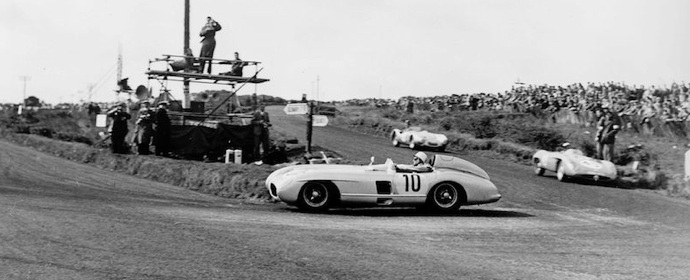
Stirling Moss, 1955 Tourist Trophy Dundrod, Mercedes-Benz 300SLR

History of the Tourist Trophy – Race Profile

By Art Evans

The Tourist Trophy is the oldest motor race in the world still being run. The first was in 1905 on the Isle of Man, organized by the Automobile Club of Great Britain and Ireland. The trophy itself is given by the Royal Automobile Club to the winner.

Over the years, Tourist Trophy races have been part of the World Manufacturers Championship, the World Touring Car Championship, the European Touring Car Championship, the International Sports Racing Series, the FIA GT Championship and the British Touring Car Championship. Although the first six were held on the Isle of Man, afterwards they moved to various other locations in Northern Ireland and England. TTs, as they are called, were not held during war years and, in addition, there were some other years without events. In all, a total of 66 have been run including 2011. For many of those years, the TT has been Britain’s foremost motor race.

Some of the world’s best racing drivers have taken part including Rudolf Caracciola and Tazio Nuvolari. Stirling Moss won it seven times! Americans Carroll Shelby and John Fitch are also among the winners.

As the name implies, the TT is for touring automobiles, although there was an interlude for sports cars and even briefly for grand prix cars. In recent years, it has been for touring vehicles. During the early years of racing, the British government did not allow racing on public roads, so there was no racing there until a purpose-built course—Brooklands—was opened in 1907. Although part of Great Britain, Northern Ireland and the Isle of Man had their own laws that permitted closing public roads for racing. So both were used for this purpose.

The first race on the Isle of Man was in 1904. Not billed as a Tourist Trophy, it was an “Elimination Trial” for the Gordon Bennett Cup event held that year. It was five laps over a 52.15-mile course won by Clifford Earl in a Napier. The Trial was held again in 1905 over the same course and again won by Earl.

As an aside, it should be noted that motorcycle races were also run on the Isle of Man. The day after the 1905 Gordon Bennett Elimination Trial, there was an elimination trial to establish a team to represent Great Britain in the International Motorcycle Cup races.

The very first RAC Tourist Trophy took place the following September, again over the same course. (Called the “Highland Course). John Napier won in six hours and nine minutes with an average speed of 33.90 mph. Regulations required a vehicle weight between 1,300 and 1,600 pounds, a wheelbase of at least seven feet, six inches and a load weight of 660 pounds consisting of driver, mechanic (or passenger) and sand ballast. Entries had to accommodate the driver and three passengers (i.e., have a back seat). Examples of the same car had to be available for sale to the public for at least a month after the event.

Forty-two cars started the race. Twenty-eight were made in England. Sixteen of the English cars finished plus two from other countries. The race was four laps over the Highland Course. Charles Rolls was a pre-race favorite, but Napier in his 3.8-liter Arrol-Johnson finished first by two minutes and nine seconds over a Rolls-Royce driven by Percy Northey. Rolls had stripped his gears shortly after the start. Napier set the fastest lap of one hour, 31 minutes and nine seconds at 34.30 mph.

The RAC decided to have a second event the following year. This time, the Isle of Man course was shortened to 40.25 miles. Charles Rolls won in a more powerful 22-hp model. In 1907, the RAC ran two races, one for lighter, the other for heavier cars. The “Heavy Tourist” was run during a storm. It covered only five laps, but even so, just two cars finished. In 1908 the course was reduced to 37.75 miles in the interest of safety.

For some reason, in 1908, 1914 and 1922, grand prix (open wheel) cars were allowed to compete. There were no TTs during 1909-1913. In 1914, the event was run over two days; each day an eight lapper. For the first time, there were cash prizes with 1,000 pounds to the winner. (A considerable sum in those days).

World War I intervened and there was no race in 1915. The next was in 1922 and then there wasn’t another until 1928. World War II came along, so there were none between 1939 and 1949.

TT 08 620x366 History of the Tourist Trophy   Race Profile

W. Watson in a Hutton (#2) and Lee Guinness in a Darracq (#4) at the 1908 Tourist Trophy on the Isle of Man.

TT 14 620x475 History of the Tourist Trophy   Race Profile

Getting ready for the start of the 1914 Tourist Trophy.

TT 22 start 620x416 History of the Tourist Trophy   Race Profile

Just before the start of the 1922 Tourist Trophy. Left to right in front: a Bentley a Vauxhall and a Sunbeam.

History of the Tourist Trophy – Race Profile Continued

Pages: 1 2

Comments

  1. andy evans says:

    I believe that the oldest race in the world is the Shelsley Walsh Hill climb.The Tourist Trophy is a revived title these days.

  2. Legendary Finds says:

    Sir Stirling Moss is the King ! Thanks for this article Love it !

Leave a Comment

About Art Evans

Art Evans has a varied and extensive background. During the fifties, he and his partner, OCee Ritch, had a public relations and advertising company that represented the MG Mitten Company, Devin Enterprises and Gough Industries among other car-related organizations.

The author of ten books about photography plus others on different subjects, Evans has written numerous articles for photography and automotive magazines as well as professional journals. In addition, he has written eleven books about motor racing.

In retirement, Evans pursues pastimes including writing about the fabulous fifties and serving as secretary and newsletter editor of The Fabulous Fifties Association.