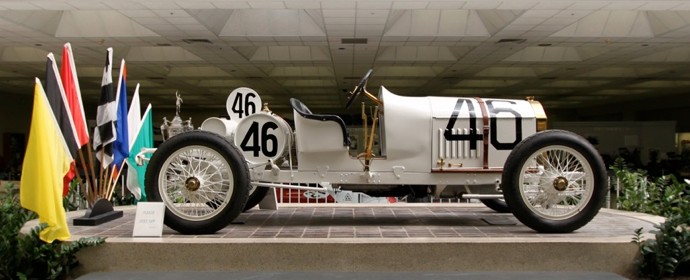
1911 Benz 150HP Grand Prix at Indy 500 Museum

Indianapolis Motor Speedway Museum – Profile

Rear-Engine Champions

A similar line of rear-engine race winners fills the opposite side of the gallery. Missing among them is Jim Clark’s 1965 Lotus 38, the first rear-engine car to win the Indianapolis 500. Clark’s Lotus is part of the permanent collection of the Henry Ford Museum. Clark’s 1963 Lotus-Ford is a part of the IMS collection, however.

3 14 Jim Clarks 1963 Lotus Ford finished second to Jones 620x465 Indianapolis Motor Speedway Museum   Profile

Jim Clark's 1963 Lotus-Ford finished second to Parnelli Jones

Bobby Unser’s Rislone Eagle-Offy won the first of many Speedway victories for Dan Gurney’s Eagles and was powered by the first turbocharged engine to win the 500, leading to an era of turbo-powered cars that will return to the Speedway in 2012. Mario Andretti’s STP Brawner Hawk-Ford was Andretti’s only Indianapolis 500 winner, in 1969, and also carried the first turbocharged four-cam Indy Ford V-8 to victory.

Other cars are equally significant, each for their own reasons. Al Unser won his first two 500s in 1970-71 in Parnelli Jones’ Colt-Ford Johnny Lightning Specials named after a toy company. Mark Donohue drove the Sunoco Penske McLaren-Offy to win the 1972 race, adding the 500 to his Trans-Am and Can-Am championships. The 1972 car was the first Roger Penske-entered winner and the first McLaren to win at the Speedway.

Al Unser won again in 1978 in a Lola-Cosworth entered by Jim Hall’s Chaparral Racing team in their first attempt at the Speedway and provided the first victory for a Cosworth-powered entry—the first of nine in a row. Hall’s Pennzoil Chaparral, nicknamed the Yellow Submarine, carried Johnny Rutherford to his third 500 victory and was the first ground effects chassis to win at the Speedway.

The 1982 Patrick Wildcat entered by oilman Pat Patrick and driven by Gordon Johncock is still the last American-built chassis to win the 500. The subsequent March-Lola era at the Speedway is represented by Tom Sneva’s 1983 Texaco Star and Arie Luyendyk’s 1990 Domino’s Pizza winners.

Jacque Villeneuve’s Player’s Reynard-Cosworth carried him to a 1995 Indianapolis 500 victory two years before he claimed the 1997 Formula One World Championship. Most recently, the 500 has been dominated by the Dallara and G-Force spec chassis, with Team Penske and Target Chip Ganassi Racing winning seven of the ten Indianapolis 500 races since 2001.

3 15 1968 1971 Rear engine 500 Winners 620x413 Indianapolis Motor Speedway Museum   Profile

1968-1971 Rear-engine Indianapolis 500 Winners

Crossing the Aisle

A second gallery is reached by crossing an atrium in which recent race winners are frequently displayed.

The automobiles displayed across the aisle are also historically significant, isolated only because they are not 500 winners. These include important early rear-engine cars like Jack Brabham’s 1961 Cooper-Climax, Jim Clark’s 1963 Lotus-Ford and Graham Hill’s 1968 Lotus Turbine car.

3 19 Jack Brabham 1961 Cooper Climax 620x465 Indianapolis Motor Speedway Museum   Profile

Jack Brabham 1961 Cooper-Climax

Other cars that might have changed Speedway history include a Ferrari 375 Indianapolis ‘Special’, one of four built for the 1952 500. Alberto Ascari’s Ferrari was the only one of four Ferraris to qualify but went out of the race early with a wheel failure. A 1938 Alfa Romeo 308C grand prix car was driven to three Top Ten finishes at the Speedway in 1946-48.

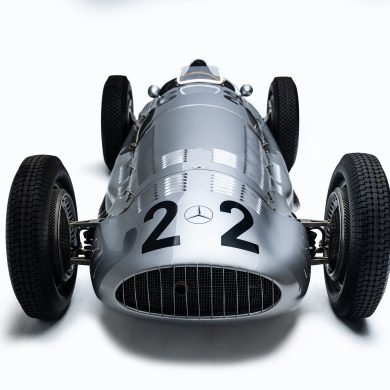
Several important sports cars have also found a home at the museum, where Speedway owner Tony Hulman actively sought other automobiles to place the 500 in historic perspective. These include a Mercedes-Benz W196 streamlined grand prix car, one of the team cars that carried Juan Manual Fangio to World Championships in both 1954 and 1955. A magnesium-bodied Corvette SS created by Zora Arkus-Dontov and John Fitch for the 12 Hours of Sebring set a 1957 lap record, but did not finish the race.

A red #21 Ferrari 250LM sits modestly among the great champions that fill the IMS Museum. Few visitors may realize that this car is the N.A.R.T. entry driven to victory in the 24 Hours of Le Mans in 1965 by Masten Gregory and Jochen Rindt—still the last Ferrari to win the 24 Hours of Le Mans overall.

3 20 1952 Ferrari Special 620x399 Indianapolis Motor Speedway Museum   Profile

1952 Ferrari 375 Indianapolis

3 21 1955 56 Mercedes Benz W196 Streamliner 620x413 Indianapolis Motor Speedway Museum   Profile

1954-1955 Mercedes-Benz W196 Streamliner

3 22 1957 Corvette SS and 1965 Ferrari 250 LM 620x413 Indianapolis Motor Speedway Museum   Profile

1957 Corvette SS and 1965 Ferrari 250 LM

Other attractions include collections of trophies, helmets and 500 art. An extensive collection of engines also displays outstanding examples of Duesenberg, Miller, Offenhauser, Ford, Cosworth and others, from different eras.

Caracciola Trophy Collection

Every visitor entering and leaving the IMS Museum passes a glass case filled with polished silver and other fine objects, but very few seem to grasp its significance—easy enough, in these surroundings. The glass case contains the complete collection of trophies and awards won by Rudolf Caracciola in his lifetime.

The connection between the Indianapolis Motor Speedway and Rudi Caracciola may be one of the least-known pieces of Speedway history, in spite of this exhibit.

Caracciola was a three-time European Champion in 1935, 1937 and 1938, the equivalent of today’s World Champion, and won more Grands Prix than any other driver between 1926 to 1939. Caracciola was entered for the 1946 Indianapolis 500 to drive a pre-war Mercedes-Benz W165. The car could not be shipped from Europe and Caracciola accepted an opportunity to drive the Sparks “Big Six” for car owner Joel Thorne. Caracciola was seriously injured in a crash while preparing to qualify for the 500 and was invited, with his wife Alice, to convalesce at a lodge owned by Tony Hulman. This began an enduring friendship, and Caracciola’s trophies were left to the IMS Museum years later.

Other Historic Automobiles

An exceptional collection of historic automobiles is also part of the Speedway Museum. IMS founder Carl Fisher envisioned the Speedway as a high-speed test track that would promote Indiana automobile development. Early rules were written to encourage stock automobiles, although this didn’t last long. New rules announced for 1930 were again intended to encourage participation by automobile manufacturers in the Indianapolis 500.

The extent of the IMS Museum collection is perhaps unknown except to a few individuals. Examples include the Indianapolis-built Stutz, whose sales slogan was “The Car That Made Good in a Day” following the first car’s success in the inaugural 500-mile race in 1911.

3 31 1914 and other veteran automobiles 620x465 Indianapolis Motor Speedway Museum   Profile

1914 Stutz and other veteran automobiles

One of the earliest cars in the museum is the Indianapolis-built 923 cu. in. Premier racer designed by Carl Fisher to race in the first Vanderbilt Cup Race on Long Island in 1904. The air-cooled Premier produced 100 hp at 1,000 rpm, but exceeded the weight limit by 300 lbs. Nearly 500 holes were drilled in the car in an attempt to lighten it, but the car was still overweight. Undaunted, Fisher drove the car at a speed of 59.21 mph at the Indiana State Fairgrounds.

This car is part of the permanent collection of the IMS Hall of Fame Museum as a tribute to the unbounded automotive passion of Carl Fisher who made the Indianapolis Motor Speedway a reality.

3 32 Premier racer designed by Speedway founder Carl Fisher 620x413 Indianapolis Motor Speedway Museum   Profile

Premier racer designed by Speedway founder Carl Fisher


Indianapolis Motor Speedway Hall of Fame Museum Information

The IMS Hall of Fame Museum has approximately 75 vehicles on display at all times, including more than 30 Indy 500 race winners. About one-third of the museum’s estimated 250,000 annual visitors tour the museum during May, the month of the annual Indianapolis 500. In addition to the cars, the Museum displays the equipment and methods used for timing and scoring from the first race to the 21st century, including a viewer-activated computer presentation that explains the progress through the years. The Museum also offers visitors the 48-seat Tony Hulman Theater, featuring a 20-minute presentation of rare historic footage and Indianapolis 500 highlights.

Hours of operation are daily from 9am-5pm March to October and 10am-4pm November to February, with extended hours during the race weeks in May. Admission is $5 for adults, $3 for children 6-15 years old and free for children under six. Gate admission is not included in the admission price to the Museum during days of Indianapolis 500 practice, qualifications and races. Gate admission price also must be paid.

For more information, visit Indianapolis Motor Speedway Hall of Fame Museum.

[Source: Leigh Dorrington]

Pages: 1 2

Comments

  1. Great write-up.  Why have I not toured the Museum in all the years I’ve gone to the 500?  This article makes me feel like I just visited.  I’ll go next time I’m in Indianapolis!

  2. Here is a link to a slide show of photos taken at the Speedway musuem May of this year. All the 500 winners since 1911 ( I think 2 or 3 were missing) were on display. Hope you enjoy. http://tripwow.tripadvisor.com/tripwow/ta-01f3-4a36-8e00?lm

  3. Rdsieber says:

    Leigh:
    Great coverage of the museum – thanks for doing this! BTW: Frank Lockhart’s crash at Daytona was April 25, 1928. I’m writing a book with his story in it. You can see a video of the fatal incident on YouTube at http://www.youtube.com/watch?v=e0y2b7mJqhs. Sad day…

    All the best,
    Ronald Sieber

Leave a Comment

About Leigh Dorrington

Leigh Dorrington is an automotive historian and contributor to automotive publications in the U.S. and Europe including AutoWeek, Vintage Motorsport, Classic and Sports Car, MotorSport, Gasoline for Swedish hot rodders and Automobile Quarterly. The common denominators in his widespread interests and subjects are automotive design and competition.

Leigh is actively engaged as a concours judge and consultant and is a director of the Saratoga Fall Ferrari Festival in Saratoga Springs, New York. He lives in a 1771 Connecticut farmhouse, where he channels a rich tradition of earlier automotive journalists and drives a Proteus Jaguar C-type.