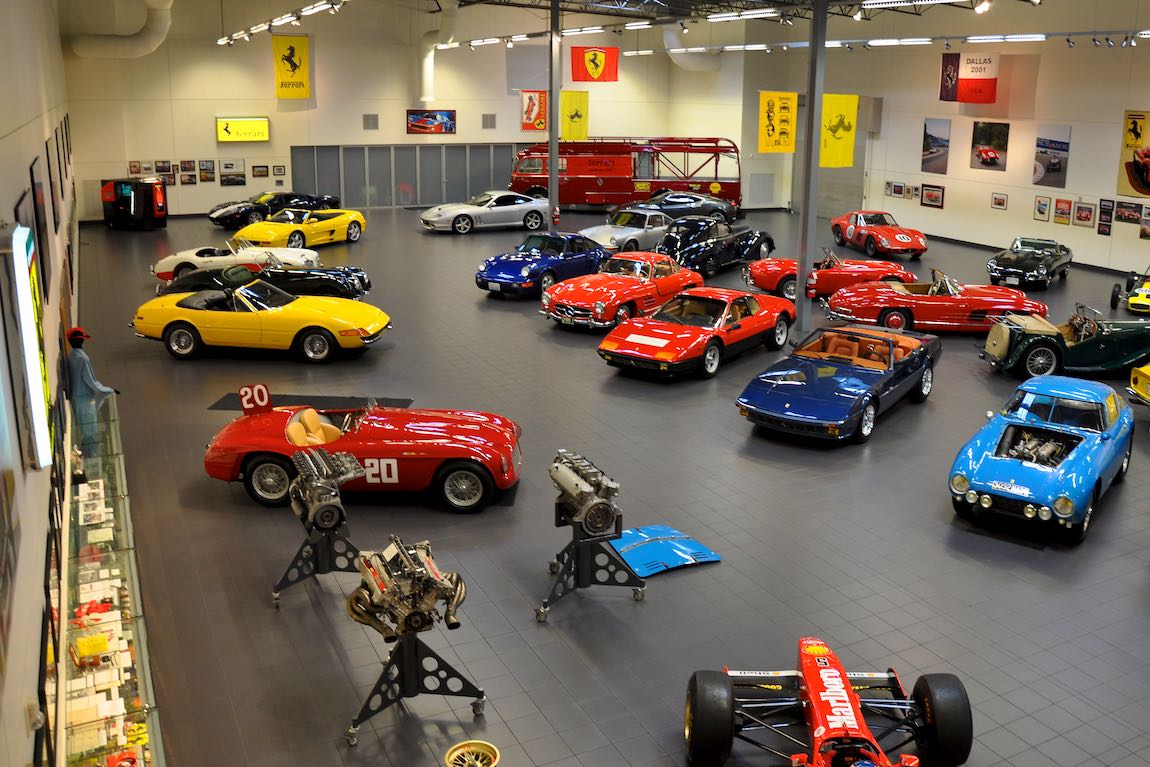
Jon Shirley Automobile Collection

Jon Shirley Collection – Interview and Profile

Interview by Dennis Gray | Photos by Gray unless noted

Jon Shirley makes good decisions whether finding and buying one-off Ferrari 375MMs or guiding Microsoft through its initial public offering.

The son of Navy man, Shirley was born in 1938 and moved with his family in 1941 to a little known place named Pearl Harbor. After the bombing, with his family thankfully well, they moved across the country according to the needs of the Navy. Jon attended a boarding school in Pennsylvania and later enrolled at MIT. Then he decided to leave college.

The company for which Shirley left MIT was a relatively small but growing electronics supply store called Radio Shack. There, Shirley’s uncanny knack for making wise decisions would carry him up corporate ladder and lead him to the Tandy corporation and then Microsoft, where he served as President from 1983-1990 as well as a member of Microsoft’s Board of Directors until 2008.

Sports Car Digest Publisher Jamie Doyle and Senior Photographer Dennis Gray sat down to interview Jon Shirley about his decisions of another sort. Namely, those that have led to his overwhelmingly impressive collection of vintage Ferraris, Alfa Romeos and significant sports racers from the ’50s and ’60s. An accomplished vintage racer and well regarded restorer of concours winning automobiles, Shirley knows as much about vintage cars as he does the computer business and his interview does not disappoint.

Sports Car Digest: Give us a short history of Jon Shirley.

Jon Shirley: I was born in San Diego. My dad was in the Navy. We were transferred from San Diego to Honolulu in mid-1941 and got bombed in December and sent home the day before Christmas. We lived all over the place; a lot on the east coast. I ended up going to a boys prep school in Pottstown, Pennsylvania called the Hill School and then to MIT. I didn’t graduate from MIT. I left and went to work for Radio Shack which got bought by Charles Tandy. We clicked. I told him I’d like to open a store for him someplace. So he sent me out to California and I opened the twenty-third RadioShack store in San Leandro, California and then became a district manager. I got sent to Europe to start opening stores and I was the vice president in the computer side of the business. I was hired by Bill Gates in 1983 as President of Microsoft. So I spent seven years in that job and decided there was a whole mess of other things that I wanted to do with my life and left the company full time but stayed on the board of directors which I only retired from a couple of years ago. I stayed on 25 years.

SCD: What was your first car?

JS: It was a Sunbeam Alpine that I bought used. I waited until I was 25 because in those days you could rent cars when you were in your early 20s at the same price. Even though the insurance for a male under the age of 25 in Boston was astronomical. Plus, finding a place to put the car was difficult. I drove the car the entire US to California when I went to open up the store. I liked the car a lot. I didn’t like the rear fins, but other than that it was a pretty nice little car.

SCD: When did you get serious about collecting cars?

JS: I started collecting in about the time that I left Microsoft. At that point I already had a three-car garage next to my house that one of the bays got turned into a workshop. For quite awhile I was pretty hands on and the collection gradually started to grow. I already had a couple of Ferraris and then when 1990 came and prices collapsed it was a really good time to buy cars and that’s when I really started. I rented space next door. It had a little office in it that might have been used for something else and we just took it the way it was. The rest of it was open. I don’t know what they’d been doing in there; screen doors or something like that. That was where the collection grew until it got just so jammed in there. You want to go drive something and you had to move four cars to get one out or more.

SCD: So you moved here?

JS: This was an empty lot. Then a sign came up one day—one of those land use signs—and I called the number on the sign. He was a developer. He was going to do either a spec warehouse or build to suit and I said show me your designs for your spec warehouse and we simply modified it. The roof wouldn’t have been this way with what he was doing. He would have had double sets of pillars. This is a fancier roof to get the span and cut down the number of pillars. But otherwise it’s got a loading door down there and it’s got knockouts in the concrete walls so someday it could have three loading doors. It could be two businesses or whatever in here.

SCD: What was the first car you bought for your collection?

JS: It’s kind of funny because you sort of have to say: “Was I buying for the collection or not?” I guess the first car would have been the Testa Rossa, which was the first older Ferrari that I bought. I do not own that anymore, but that was really the beginning of what’s here. And then I just started to see what was around and the [Ferrari 275 GTB/4] NART Spyder was part of a three-car deal. It included the Daytona Spyder which was a one-owner car, and a 400 Superamerica Pininfarina Cabriolet. I kind of just found things here and there like the [1954 Ferrari 375 MM] Rossellini car that was in parts in France. That was a great buy. It was difficult to get, but well worth the effort.

DSC 07651 620x413 Jon Shirley Collection   Interview and Profile

Giallo Fly 1967 Ferrari 275 GTB/4 NART Alloy Spyder

DSC 0780 620x413 Jon Shirley Collection   Interview and Profile

Ferrari 365 GTB/4 Daytona Spyder

SCD: Why did you buy the particular cars in your collection?

JS: Well, the collection is almost two collections. One of them is Ferraris and Alfas. The other one is sports cars from the 50s and 60s that I either owned, got the chance to drive, or wanted to own. So that includes things like the two Jags, the Cobra, and the 300SLs. But the thought process on the Ferraris and the Alfas is the same sort of the process we do with the art collection. I wanted to buy things that were “museum standard.” I just wanted to get cars that had really good histories if they were racecars, or that were reasonably unique. So the long wheel based California Spider is a competition car. The NART Spider—even though they are very rare to begin with—was the second one made and it’s one of only two made out of alloy. The Maserati was a factory team racecar that ran in the Mille Miglia for the factory. The 166 had a famous race history, both in Europe in ‘49 and in the United States in ‘50 and ‘51. It was the first Ferrari to win a race in the State of California when it won the race at Palm Springs. The GTO is an English GTO. It’s spent all its life in England, but it was raced by Graham Hill, Richie Ginther, Roy Salvadori and Jack Sears, of course, who later bought the car after it stopped racing and made it his daily driver for 29 years. So it wasn’t a Le Mans car but it had a great race history in England. That’s kind of what I try to do. I like to get cars…significant I guess is one way to put it.

DSC 07771 620x413 Jon Shirley Collection   Interview and Profile

1949 Ferrari 166 MM Touring Barchetta finished 1st overall at the 1949 24 Hours of Spa at the hands of Luigi Chinetti and Jean Lucas

DSC 0736 620x413 Jon Shirley Collection   Interview and Profile

1962 Ferrari 250 GTO of Jon Shirley

SCD: Does emotion influence your purchases?

JS: Oh yeah, oh yeah. I think so. I think that…some cars like the Rossellini car was the greatest no-brainer of all time. When I had the chance to buy the car I was going to get that car because I thought it was one of the most beautiful Ferraris ever made. It’s won best in show at the factory in the 60th anniversary of Maranello. It won best road car which I thought was really a great award for the car. It won best of show in at the Ferrari Nationals and a bunch of awards. But yeah I…why do I have a 289 Cobra and why do I have a Gullwing? The first time I saw them I just thought they were fantastic. The 289 is just a fantastic little car because the engine doesn’t weight enough to really upset the whole car. There isn’t that much lump up there compared to the old Bristol engine that they put in them. Shelby did a great job with the way they sorted that car out.

SCD: Any others?

JS: When the E-type was introduced in the United States I was living in Boston. I was in New York on business with a friend. We didn’t have anything to do that afternoon I guess so we said let’s go to the Coliseum and see the car show. We read something that there’d be a new Jaguar there. It took us an hour to get from the edge of the crowd into where you could actually see the car. I understand now why the crowd was in there. To me it was the most spectacular car. You have to think back to that year. That was what? 61? That was an amazing automobile in 1961 and I just fell in love with that too.

DSC 6087 1 620x354 Jon Shirley Collection   Interview and Profile

1954 Ferrari 375 MM - One-off Carrozzeria Scaglietti body commissioned by Robert Rosselllini.

Jon Shirley Collection – Interview and Profile Continued

Pages: 1 2 3 4 5

Comments

  1. David Singh says:

    Great interview with Mr Shirley. What a treat that must have been to see all of those great cars in one place. You would have needed to yank me out of there! The Rossellini 375MM is the best in my book.

  2. Jamie-

    Great job on the interview with Jon Shirley. I’ve been to his place a couple of times for SOVREN
    related events, and it is just spectacular. I really like the fact that he takes the cars out and uses
    them – though I will miss seeing the 250TR out on track. I’ve had several opportunities to photograph
    it in competition – just beautiful, I think one of my favorite vehicles in his collection is the Fiat car transporter.
    That, and the memorabilia collection….
    Really enjoyed the piece, and I can’t wait for the vintage racing season to start. I’ll be sure to get you
    race reports and photo’s as before.

    Thanks-

    Marshall Autry

  3. The ultimate collection. Thoroughly enjoyable – thanks guys.

  4. Andrew Garmond says:

    A great and very informative read. Superb pictures too. Having been there myself, I’d say you perfectly captured the place.

  5. Gary Walken says:

    Thanks for another magnificent article. I really hope you guys are making money at this because I really cannot imagine where I would get such great classic car ‘news’ on the internet.

  6. Anonymous says:

    Actually, quite boring. At the end of the game a building full of toys with none of them really more than purchases. Quite sad. I read the interview, additonally boring. Many great collectors have a ”touch”, like Fred S, Miles C – this collection is just about purchasing strenght, much like the front row of an auction. Here today, and gone tomorrow. I rank him with Mullin – an empty vessel.

    • Ed Markowitz says:

      Anonymous – Did you read the same interview as me? I thought it was one of the most interesting interviews I’ve read, especially by a car guy. And rest assured, Shirley is a car guy through and through. Sure, the collection has the “strenght” [sic], but it also has the cars that meant great things to him along the way, like the Jaguars, MG and Austin-Healey.

    • Anonymous says:

      Sour grapes?…..

  7. Mark Petry says:

    very enjoyable article and pictures. Thank you !

  8. Herb Luhman says:

    Who wouldn’t want to be Jon Shirley? Saw his GTO at Colorado Grand and at Cavallino. His cars are magnificent!
    Thanks for the article.

  9. roger morrrison says:

    I have been on several driving events in which Jon was driving his cars. He is a true enthusiast who is willing to put his cars on the road for all of us to enjoy. Nice to see his son,Erick driving the GTO with dad: great father/son experience.

  10. Jim Fraser says:

    Hats off to Jon Shirley! Few people would have the resources or the opportunities to do what he has done.. But his combination of dedication. enthusiasm and taste is very rare. And he has such a great attitude about it all. Thanks for both the interview and the gallery of pictures.

  11. So that’s where the beautiful transporter ended up! I remember Talacrest advertising it last year.

  12. Paul Smith says:

    Another great interview comng across these pages, the fascination of Jon Shirley with supurb autos, and sharing it with us in this manner is to be appreciated rather than to be demeaned by someone who has such small stature that he was named “Anonymous.” Thanks SCD and Dennis for taking us into Mr. Shirley’s garages, both the physical and mental ones.

  13. The only thing that would make his collection better would be some etceterinis: Bandini, Stanguellini,
    Abarth, Moretti etc. Just kidding! What amazing taste and it looks like he uses the heck out of them so hey Anonymous stop making silly comments!

  14. Dick Irish says:

    I enjoyed the comments about the Germans with their “biohazard suits”. My late brother Chuck and I were running a midget back in Ohio in the late 1940′s. A fellow by the name of Carl Geise worked for Holly Carburetor Co., and he had been a Major (as I recall) at the end of WW II and was one of the Army technical types to enter the Mercedes works and uncover the record car amongst other things. One of the things he got was the Mercedes fuel formula. This he shared with a few of us lucky ones. It consisted of Alcohol, amyl acetate, nitro benzine, a touch of castor oil for “upper lube”, and a few other things that are lost to senility. Mixing it weas a several step operation and if not followed properly, resulted in a bunch of unuseable jello! The exhaust fumes made your eyes water BIG TIME! The “shoe polish” smell was great though!

    Dick Irish
    Edmond, OK

  15. Absolutely beautiful collection. Amazing showroom of cars. WOW!!! A great story too!!!

  16. What a beautiful collection and storage facility. Do you ever just take them out on the road on a nice day and wear it out like it was stolen?

  17. James Nikon says:

    Beautiful collection of cars. I’d like to see more of these, interesting!

Leave a Reply

About Dennis Gray

Senior Photographer Dennis Gray was team photographer for George Dyer Racing when they won the 12-Hours of Sebring in 1977, team photographer for Tom Spalding’s Can-Am team in 1978 and the RJR photographer for the IMSA series in 1979 and 1980. He was a frequent contributor to On Track magazine from 1968 to 1985.

Gray has created images for many automotive firms including BMW; Ford; Goodyear; Jaguar; Mercedes-Benz; Pirelli and Porsche; in addition to many print publications. He is a member of the American Auto Racing Writers and Broadcasters Association. To see more from Dennis, visit DennisGrayPhotographer.com.