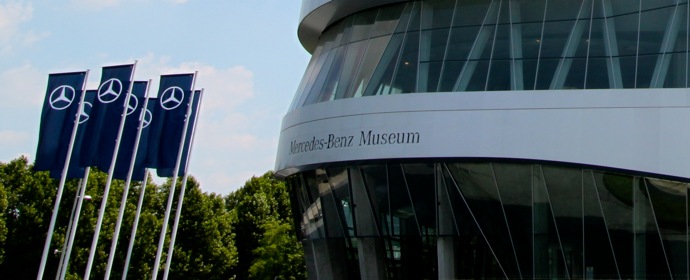
Mercedes-Benz Museum building

Mercedes-Benz Museum – Profile and Photos

Silver Arrows

Other exhibits detail more recent Mercedes-Benz leadership in safety, efficiency and the environment.

MB 8 1 1960 1982 620x413 Mercedes Benz Museum   Profile and Photos

1960-1982

But after viewing the 300 SLR, most readers would hot foot it directly to the final exhibition, that displays well over a century of dominating racing cars produced by Daimler, Benz and Mercedes-Benz.

One exhibit hall displays contemporary championship-winning Mercedes-Benz representing Formula 1, Le Mans, Indianapolis, the DTM German Touring Car Championship—even truck racing.

But for the initiated, it is the counter-balance of great racing cars from an earlier era that closed, seemingly forever, with Mercedes-Benz’ withdrawal from racing after the successful 1955 season that have drawn us to the museum.

MB 8 2 W196 Streamliner 620x413 Mercedes Benz Museum   Profile and Photos

Mercedes-Benz W196 Streamliner

This is a hall of immortals. The 1955 Mille Miglia-winning 300 SLR sports car “722” driven by Sir Stirling Moss with co-pilot Denis Jenkinson is sometimes described as the most important automobile in the world.

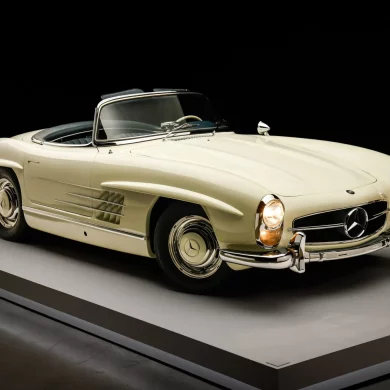
The 1952 Carrera Panamericana-winning 300 SL did much to establish Mercedes-Benz with post-war American buyers, and is the same design that won the 1952 24 Hours of Le Mans.

MB 8 3 300 SLR 722 620x413 Mercedes Benz Museum   Profile and Photos

Mercedes-Benz 300 SLR 722

Tucked to the inside of the track are a pair of Mercedes-Benz W196 Grand Prix cars driven by 1954-1955 World Champion Juan Manuel Fangio and Moss. The W196 Grand Prix car was designed to new rules for 2.5-liter cars beginning in 1954.

The W196 straight-eight GP engine was made up of two, 4-cylinder blocks with camshafts driven from the center. A revolutionary desmodromic valve train eliminated the need for valve springs and allowed for higher rpm.

Other features carried over from the 300 SL sports car into the W196 GP car were Bosch fuel injection and a space frame chassis design that provided both light weight and exceptional strength.

With typical thoroughness, Mercedes-Benz developed both open-wheel and fully enclosed streamlined versions of the W196 GP. The W196 was good for than 184 mph, or 300+ km/hr. The open wheel and streamlined variations were selected—like a tire choice—as each was best suited to a given GP course.

The W196 won five of seven races entered in the 1954 Grand Prix season, beginning at the French GP at Reims in July, and five of nine races in 1955.

MB 8 4 Mercedes Benz W196 300 SLR 300 SL 620x413 Mercedes Benz Museum   Profile and Photos

Mercedes-Benz W196 - 300 SLR - 300 SL

MB 8 5 Mercedes Benz W196 Exploded View 620x413 Mercedes Benz Museum   Profile and Photos

Mercedes-Benz W196 Exploded View

MB 8 6 World Champion 620x413 Mercedes Benz Museum   Profile and Photos

World Champion

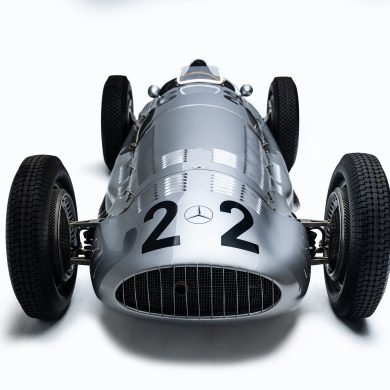
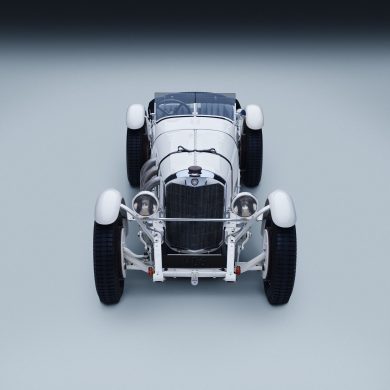
Only a few meters behind are the pre-war W154, W125 and W25 Mercedes-Benz Grand Prix cars of the 1930s—cars that gave rise to the name “Silver Arrows”. Earlier German race cars were painted nationalistic white, but the dominating GP cars of the mid- to late-1930s carried a simple silver finish. Apocryphally, the change was made to save the weight of the paint!

But the lasting change was to remake Grand Prix racing. With the direct support of the German government, Mercedes-Benz—and Auto Union—destroyed the competition and saw off venerable marques like Alfa Romeo, Maserati and Bugatti from GP racing. Streamlined versions of the Mercedes-Benz Grand Prix cars were also used to set records on German autobahns.

MB 8 7 1930s Mercedes Benz Silver Arrows 620x413 Mercedes Benz Museum   Profile and Photos

1930s Mercedes-Benz Silver Arrows

Pages: 1 2 3 4 5 6

Comments

  1. Richard Mulligan says:

    Another great Dorrington article!

  2. I visited the Museum with my brother this past summer and it was outstanding. It is definitely worth an afternoon as it not only traces the history of Mercedes Benz, but it does a tremendous job of showing the impact of the automobile and motorized transport on the world over the past 125 years. Don’t miss it if you’re in Stuttgart!

Leave a Reply

About Leigh Dorrington

Leigh Dorrington is an automotive historian and contributor to automotive publications in the U.S. and Europe including AutoWeek, Vintage Motorsport, Classic and Sports Car, MotorSport, Gasoline for Swedish hot rodders and Automobile Quarterly. The common denominators in his widespread interests and subjects are automotive design and competition.

Leigh is actively engaged as a concours judge and consultant and is a director of the Saratoga Fall Ferrari Festival in Saratoga Springs, New York. He lives in a 1771 Connecticut farmhouse, where he channels a rich tradition of earlier automotive journalists and drives a Proteus Jaguar C-type.