Remembering Carroll Shelby – Page Three
By November, the Shelby American Cobra production line had been worked out to produce one car a day. Meanwhile, Norman Garrad, the Western States distributor for another British car manufacturer, the Rootes Group, took notice of the Cobra. Rootes was making the Sunbeam Alpine, a great but underpowered car. So an engineless Alpine was delivered to Shelby American with an order to install a small-block Ford. At the same time, another roller was sent to Ken Miles, who had a nearby independent shop, with the same order. Miles, with Garrad helping, completed the job over a single weekend. It took a little longer at Shelby American, but that Shelby one turned out to be the prototype Sunbeam Tiger.
Shortly thereafter, Miles went to work for Shelby and became perhaps the most important Shelby employee. Ken and Davy MacDonald (who had left Chevrolet for Shelby) were entered at an SCCA Regional race at Riverside on January 2-3, 1963 in Production Class A. Showing the Sting Rays the way home, Miles was first on Saturday (the 2nd) with Davy second. On Sunday, Miles made a pit stop after the first lap, letting MacDonald capture the win. From dead last after his stop, Ken passed everyone except Davy to take second. The best Corvette was Dick Guldstrand in third. From then on, Cobras dominated most SCCA events. With similar power, they were some 1,000 pounds lighter than a Corvette.
The Shelby Cobra’s first entry in international competition was the Daytona 3 Hour Continental on February 17, 1963. Davy MacDonald managed a fourth. At the 12 Hours of Sebring the following month, Miles, Phil Hill and Lew Spencer were eleventh. It should be noted that these events included sports-racing cars like Ferraris and Maseratis. These results were excellent in that the production Cobras were up against all-out race cars.
By June, Shelby American had completed 125 Cobras. Carroll wanted to enter Le Mans, but Ford declined to finance the effort because it didn’t want to have to deal with negative publicity if the cars did poorly. So Shelby put together a deal with AC Cars and Ed Hugus with each fielding a car. The AC entry finished 7th with only Ferraris ahead. Ed was disqualified for adding oil before his first 25 laps has been completed. By the end of 1963, a Cobra had won the SCCA A-Production National Championship as well as the United States Road Racing Championship.
In February 1964, Shelby American completed the first FIA roadster as well as the Daytona Coupe. In June, a Daytona Coupe driven by Dan Gurney and Bob Bondurant placed fourth at Le Mans and first in the GT class. In September, the first GT350 Mustangs were completed and the next month, the first 427 Cobra. A 289 Cobra again won the SCCA A-Production National Championship. In January 1965, there was a press introduction for both cars at Riverside International Raceway.
In 1965 Shelby moved his facility to two large hangers on the edge of Los Angeles International Airport and Ford turned its Ford GT (GT-40) project over to Carroll. A Ford GT won Daytona and a Daytona Coupe won the GT class. Bondurant and Jo Schlesser took first overall at Sebring. When all the dust settled that year, Shelby had wrestled the FIA World Manufacturers’ Championship in the GT category away from Ferrari, much to the delight of Henry Ford II (The Deuce).
1966 turned out to be the year of Shelby’s greatest triumphs and deepest tragedy. Ken Miles and Lloyd Ruby won the Daytona Continental and again at Sebring in a Ford GT. Miles and Denny Hulme were well on their way to a victory at Le Mans and Ken to the so-called triple-crown of racing when some unusual pit signals gave the win to Bruce McLaren and Chris Amon in the Ford that had been following along in second. Shelby and the Ford GTs completely dominated international sports car racing and won the World Manufacturer’s Championship. But Shelby’s close friend and key employee, Ken Miles, was killed on August 17 while testing a new Ford sports-racing car—the so-called J-Car—at Riverside. (Ken’s best friend, my father, Art Evans Sr., delivered the eulogy at the funeral).

The finish at the 1966 Le Mans with GT-40s first, second and third. They were uncompetitive until they were modified, prepared and tested at Shelby American. Shelby won the FIA World Manufacturers’ Championship for Ford. (Photo: Shelby Collection)
Shelby won again at Le Mans in 1967. Another highlight that year was Carroll’s first chili cook-off. But the rest of the decade was a slow decline for Shelby American. The company lost its lease on the LAX facility and moved Shelby Racing and the Shelby Parts Company to Torrance, California with Shelby Automotive moving to Livonia, MI where Shelby Mustang production continued under Ford supervision. The following year, the last Cobra was sold. In 1969, the Mustang project ended due to declining sales and Shelby American closed its doors. In 1970, Ford ended its racing agreement with Shelby even though a Ford GT had won again at Le Mans the previous year. Due to the fact that Ford’s market penetration had not increased after seven years, the Deuce said, “We’re out of racing.”
In 1970, Carroll started to explore Africa—including Botswana, Angola and the Central African Republic—where he spent approximately nine months of every year during the seventies as a safari tour operator. When I asked him why he went to Africa, he replied, “I wanted to see it.” Even so, he maintained a home in Southern California at Vista del Mar and then moved to Playa del Rey.
Even while spending a great deal of time in Africa, Shelby remained in business in the U.S. The Shelby-Dowd Wheel Company was established in January 1973. The company, headquartered in Gardena, California, manufactured and distributed aftermarket specialty wheels. The Shelby-American Automobile Club was started in September 1975. The idea caught on and today there are Shelby clubs in many larger cities and even in some smaller ones.
Through his friendship with Lee Iacoca, Chrysler and Shelby inked an agreement in October 1982 for Shelby to produce high-performance vehicles based on Dodge components. The prototype Dodge Shelby Charger was introduced the next month. Shelby followed through with a total of 20 different models through 1993. They included a van and a pickup. In 1989, Shelby created a new Can-Am car using a modified 3.3-liter Dodge engine with the body designed by Pete Brock. His intent was to recreate the Can-Am series. It didn’t take hold in the U.S., but a series using them was formed in South Africa.
In November 1989, Shelby began production in Gardena of 427 S/C Cobras using serial numbers “leftover” from 1966. Some controversy arose among aficionados as to whether or not these were “real” Cobras.

In 1999, Shelby went back into the Cobra business and introduced the CSX 1000 427 SC. It was followed by the CSX 4000, 7000 and 8000. (Photo: Shelby Automobiles, Inc.)
- In 1989 Shelby created a CanAm car using a Dodge engine. Only 76 of them were made and cost $35,000 each. (Photo: Hayes Harris)
- In 1982 Shelby contracted with Chrysler to create performance cars based on Dodge products. (Photo: Carl Goodwin)
Shelby received a heart transplant at the UCLA Hospital in June 1990. As it turned out, he eventually became one of the longest-lived among those who received a transplanted heart. During that time, Shelby became aware of the high costs involved. He also noticed that some couldn’t afford it, particularly the parents of children. So the year following his operation, he created the Carroll Shelby Children’s Foundation to help fund heart transplants for needy children. Shel became personally involved in finding kids who needed help. He has told me a number of stories about some of them. The first recipient, an infant named Leah Smith, required heart transplant medication. She was within days of dying because her parents didn’t have the money or insurance. Because of Shelby, Leah grew up to be a healthy woman and a figure skater. Shelby’s cars were featured and Shelby was honored at the November 1991 Palm Springs Vintage Grand Prix (organized by me). The proceeds from the event were donated to his foundation.
Shelby drove the Indy 500 pace car—a Dodge Viper—before the 1991 race and he was inducted into the International Motorsports Hall of Fame that year. The following year, he was elected to the Motorsports Hall of Fame of America.
Every Labor Day weekend there is a vintage race at Lime Rock Park. In 1992, Shelby entered an exhibition race in Rick Kopec’s GT350-R. Surprise, surprise, he turned a 1:09 lap, just 0.4 seconds off Bob Johnson’s time when he won in the same model in 1965! In 1995, Shelby was honored with the Lindley Bothwell Lifetime Achievement Award.
From the ground up, Carroll designed and then produced the Shelby Series 1 sports car in 1997. It is a high-performance roadster powered by an Oldsmobile 4-liter engine with a top speed of 170 mph. Only 248 were made, but each example is a highly-prized collectable.
Starting in 1999, Shelby started to produce new Cobras and Shelby Mustangs. Shelby Automobiles was formed and located in Las Vegas. The Ford factory ships Mustangs there where they are transformed into Shelbys. Today, a Shelby Mustang is the top of the line at Ford dealers. The Shelby GT500 was announced at the 2005 New York Auto Show. The next year, the first example was sold at the Barrett-Jackson Auction for $600,000 which was donated to Shelby’s Children’s Foundation by the Ford Motor Company.
Shelby Automobiles began production of 500 new Shelby GT-H coupes in March 2006, resurrecting the legendary GT350Hs made for Hertz in 1966. An original GT350H was sold at the Barrett-Jackson and the first new H example sold for that same amount.
On April 4, 2007, the 2008 Shelby GT500KR was introduced, marking the 40th anniversary of the original. At the same time, a “Super-Snake” package was announced that would produce more than 700 bhp. And Shelby formed a partnership with Scott Drake Enterprises to market Shelby performance parts.
Today, Shelby American in Las Vegas makes “continuation” Cobras including the 427 S/C, 289 FIA and 289 street version as well as the Shelby Mustang GT350 and the GT500 Super Snake sporting 700 horsepower. Just before he fell ill last year, Shel told me that he was planning a 1,000 horsepower model!
In 2008, Shelby was named the Automotive Executive of the Year. In the fall of that year, my book, Carroll Shelby, the Race Driver, was published in soft cover. It includes a number of descriptions of experiences written by Shelby as well as a large number of photographs—many from Shel’s daughter, Sharon—never before made public. The following year, Shelby had the book published in hardcover. In 2010, another book I authored, The Shelby American Story, was published. It recounts all of Shelby’s sixties-era car design, manufacture and racing. Both are still in print and are available at EnthusiastBooks.com.
For some considerable time, Shelby and I have been close friends. My son, David was his right-hand man and I am grateful to David for doing so much to help Shel, particularly during his final years. Shelby fell ill after Thanksgiving last year. Between then and the new year, David took Shelby back and forth to the hospital numerous times. Shelby hated being in the hospital and when he felt a little better, he would call David to take him home. Then he would get worse and David would have to take him back again. I talked with him often via cell phone. After the turn of the year, however, he was confined to intensive care until his demise. A few weeks before his demise, his sons moved him from Los Angeles to Dallas.
Danny Kaye used to say, “Life is a great big canvas. Throw all the paint you can at it.” Surely this is what Carroll Shelby did, and in spades.

My son, David, had a very special relationship with Shelby. He was not only Shel’s right-hand man, but also his companion and confidant. (Photo: Art Evans)

My nine-year-old grandson, Austin, was very fond of Shelby, who had a special affinity for children. (Photo: Art Evans)
–
Note: I am indebted to Shelby American Automobile Club honcho Rick Kopec and noted motorsports journalist William Edgar (John Edgar’s son) for their help with this article. Sports Car Digest readers will also want to take a look at Edgar’s article, “Carroll Shelby – The Edgar Ferrari and Maserati Years”.
[Source: Art Evans]


What an informative and concise aticle on Carroll Shelby’s life! That it is 3 pages long is a measure of the richness in Mr. Shelby’s life. Thank you Art. Very well done.
Dave Ferguson
R.I.P. Carroll. A monumental man. Frank Foster. ex CSX3150
Art:
Thanks for posting this summary, but especially the photos from his life. I find his family photo with trophies oddly endearing – my belief is that he had gathered all that was important to him in that photo. My condolences to the family.
Shelby is an American icon, an old-fashioned bootstraps-to-glory kind of guy who earned his money the traditional way: blood, sweat, and toil. My hope is that he will inspire the newer generations to work as hard at the dreams that they hold dear.
My first experience with Mr Shelbys cars was a rented GT350H (rented from hertz by an older co worker as I was only 16 years old.) This car went from the prom to a night of non-stop boulevard racing… Needless to say I was SNAKE BIT as I remain to this day. Mr Shelby thank you ever so much for allowing me this experience as well as being a true example of American pride and values not to mention work ethic that has all but vanished these days . RIP Frederick Kilian
Beautifully written. I would like to add a link of this on our blog in remembrance of Mr. Shelby as well.
@ http://frecksautoart.com
Art:
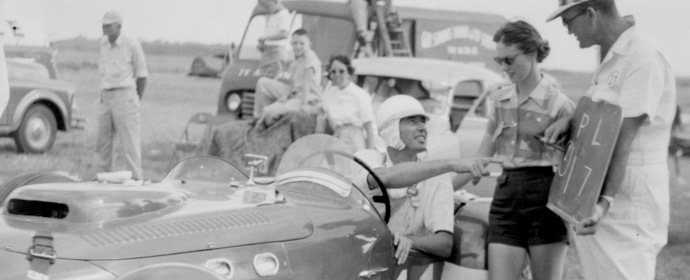
thanks for tribute to Shel…like yourself I was at Torrey Pines July 11, 1955 for his win but your photo is not Ferrari 4.5 butinstead Maserati 300 S of 1957, Carroll wassome driver..rival to Hill in US then. wish more obits would focus on his driving talent
jim sitz
Oregon
Our condolence to the Shelby family and relatives.
At this time, there are few men who contributed to the American sportscar scene with cars such as the Shelby AC Cobra.
One of Carroll Shelby’s friend or competitor is also up in age and produced the super fast Griffith 200′s and the heavy duty Griffith 400 and that is Jack Andrew Griffith who lost his wife Marge last year and who now resides in Jacksonville, Florida. Instead of using an AC Bristol body and chassis Jack Griffith used the TVR Grantura and created a super fast American sportscar. See the Griffith 400 run with the AC Shelby Cobras on: 2011 Silverstone, Gentlemen Drivers, UK on U-Tube.
When men such as Jack Griffith and Carroll Shelby put their heart and souls into a project you get a legend of an automobile!
With consolation
Chuck Pineda of the Griffith 400 Club
The photo of Shellby in the cockpit of the 375 MM….. I think this is a 300s Maserati instead!
Ciao from sunny Italy
Stephen