Sir Jackie Stewart – Speaking Out of The Box – Page Four
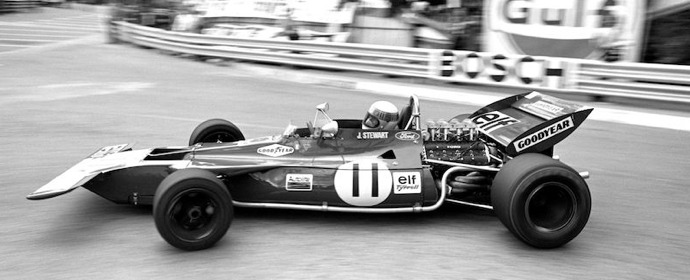
Stewart’s ninth season in Formula One would be his final rounds of Grand Prix racing. He tells about that time 39 years ago in this telephone interview from South East England.
“1973 brought the World Championship to me for the last time. I had made up my mind in April ’73 that I wasn’t going to do any more than one last season. I didn’t tell anybody other than Ken Tyrrell and Walter Hayes, who was the vice president of Ford Public Affairs, and I had a good season that year. I did win the World Championship. But I would have retired in any case whether I had won the championship or not.
“My Monza race that year, in ’73, was a good one, because of having the early puncture, and wheel changing was not what it is today. I mean, I don’t know how many times I broke the lap record that day but I think more than anybody ever has. We never really had any hope of finishing fourth when I started off very much last at the very beginning of the race almost, so it was for me, although I didn’t win it, one of my best races ever.”
Stewart’s Formula One driving career would have counted 100 Grand Prix races, if he had finished 1973 as planned. But that would not happen. While qualifying for the United States Grand Prix at Watkins Glen in New York on the morning of October 6th, Jackie Stewart’s 29-year old protégé and teammate, Francois Cevert, was killed instantly when his Tyrrell-Ford spun and struck a guardrail at 150 mph. Stewart, in his driving suit, later stood with his fellow racers during a minute of silence in tribute to Cevert. Then, as the other drivers walked to their cars to resume qualifying in Saturday afternoon’s session, Jackie Stewart, aged 34, stepped from the ranks and retired to the Team Tyrrell motor coach. Stewart’s professional driving ended that resolute moment with a record 27 Grand Prix wins.
“The people I raced with, Bill, were the best,” Stewart tells me from his car. “I’m on record for saying many times ‘the engineers and the mechanics I had were better at what they did than I ever was at what I did.’ Roger Hill and Roy Topp and Roland Law and Keith Boshier and Neil Davis, that group of people were just fantastic. And Ken Tyrrell, I couldn’t have asked for a better man—first of all to break me into single-seater racing and then to take me to where I turned out to be. Without him I probably wouldn’t be here today, because I’d probably been dead, and secondly you wouldn’t be doing an interview because maybe I wouldn’t have been successful, so Ken was a pretty important man in my life. In those days, Edsel Ford came around to the races, and Edsel is still one of my best friends. He was with me on my last ever race that I was supposed to have run at Watkins Glen when Francois was killed, so with Edsel we’ve shared a lot of things together.”
For as long as I’ve known him, Stewart has been represented by IMG, and even today remains one of this 130-office worldwide company’s most distinguished clients among the hundreds of elite athletes who have called IMG their agents and financial advisors. My own documentary film career for 20 years was tied strongly to Mark McCormack’s IMG and its then-media arm, Trans World International. When I ask Sir Jackie to reflect on his years with IMG, it’s something like talking again of old school chums and times gone by.
“Mark McCormack,” he tells me on his mobile, “signed me up himself and I had a great relationship with Mark. He was the best. He was the most powerfully involved man in sport of any kind. I had the highest regard for him, and I am still with IMG today. Jay Michaels and Jay Lafave were the other guys. Jay Lafave was the sort of administrator. And Barry Frank was TWI, Trans World International. All of these people were good. They were amazing years. But on the other hand, between sweet and sour, when you think of all the people who died from Jimmy Clark to Piers Courage to Jochen Rindt to Francois Cevert to Roger Williams to Lorenzo Bandini to Ludovico Scarfiotti to Jo Schlesser to Mike Spence—so many people died. I mean, Helen and I, and you have probably read this in the book, counted up fifty-seven people who we knew well enough, if not a deep friend then certainly acquaintances and people we mixed with a lot, who were, you know, taken out. So the experiences were very varied in those days. I mean, to do Can-Am and Formula One, to do sports cars and GT racing, touring car racing, and Indianapolis by the way, which I really enjoyed doing in the two years I raced there was ’66 and ’67, and I could have won it. Two laps in the lead! And then, to be able to go back as a commentator was very enjoyable. I liked Indianapolis and the people that were there.”
By now, we’re getting around to what Sir Jackie has been doing in more resent years and up through 2011, and at this time looking to the 2012 Formula One racing season that kicks off the third week in March at the Albert Park Circuit in Melbourne, Australia. I ask him what it has been for him to witness change with these new-era Grand Prix venues and the impact they have on Formula One today.
“Obviously the new races are going to both the Middle East and the Far East, in the sense that it all started off really in Malaysia, the first one, and I was there,” says Stewart of the current trend. “Then Bahrain came in, and China came in, Singapore, then Korea came in after Abu Dhabi. India is the very newest one. It’s going to be quite difficult for a while because there isn’t a motorsporting culture in most of these countries. And, of course, the world is becoming more motorized, and that’s why Formula One has been able to become the largest television sport in the world on an annual basis. The Olympics are bigger and so is the Soccer World Cup, but they only happen every four years. But with an aggregate of four years, Formula One is still ahead. And there are more road users than ever before, more people, men and women, driving cars. So, with these new venue countries, it will take a while before they fill the bleachers, or the grandstands.
“It’s nice to go to these new countries,” Stewart continues. “I’ve been in these countries when I was doing my world tour with Ford and Goodyear, so all of them, including India and Korea and China—I never went to China before, actually—but Singapore I used to go to, and some in the Middle East, and that region has become very important. So, it will take a while before we get drivers from all of those countries. It might be really ten to twenty years before we see really competent drivers coming from that neck of the woods because there are no local race tracks. You know, you build a big Grand Prix track, but there’s got to be kart tracks in every city in each country in order to bring young talent along. So you’ve got to start them off at eight, nine and ten years of age, really. There’s not a single Grand Prix driver today that’s not been a karting champion, so that has to happen. But it’s a healthy spreading of the world of Formula One.”


I’ve always been a huge fan of Jackie Stewart, in addition to William Edgar’s work. This brings two of my favorites together in a lovely way, like going on a great drive through the country. Perfect reading for a cold Saturday. Thanks to all!
It’s Scottish BURR, not Scottish brogue.
Wonderful interview with a driver I respect the most of all. This article brought to life the depth of Stewart’s commercial involvement outside the cockpit-especially television. As if driving in the Can-Am and F1 in 1971 wasn’t enough. After having all this other activity documented, it is a wonder he survived with all that distraction.
Thanks for a great piece.
What a thrill to see Jackie Stewart at this years Daytona 24 , strolling through the garage area surrounded by fans both young and old seeking photos and autographs. It was a flashback to the early 70′s and my first Grand Prix at Watkins Glen , N.Y. Jackie Stewart is still the fans favorite. A true Champion.
Thanks Will
Great interview and pictures. Was especially pleased to see Jackie in the Can Am L&M Lola at Road Atlanta 1971. As a 16 year-old kid attending my first international motor race, I had the great priviledge to see Sir Jackie in one of his greatest drives on July 11, 1971.
Thanks.